
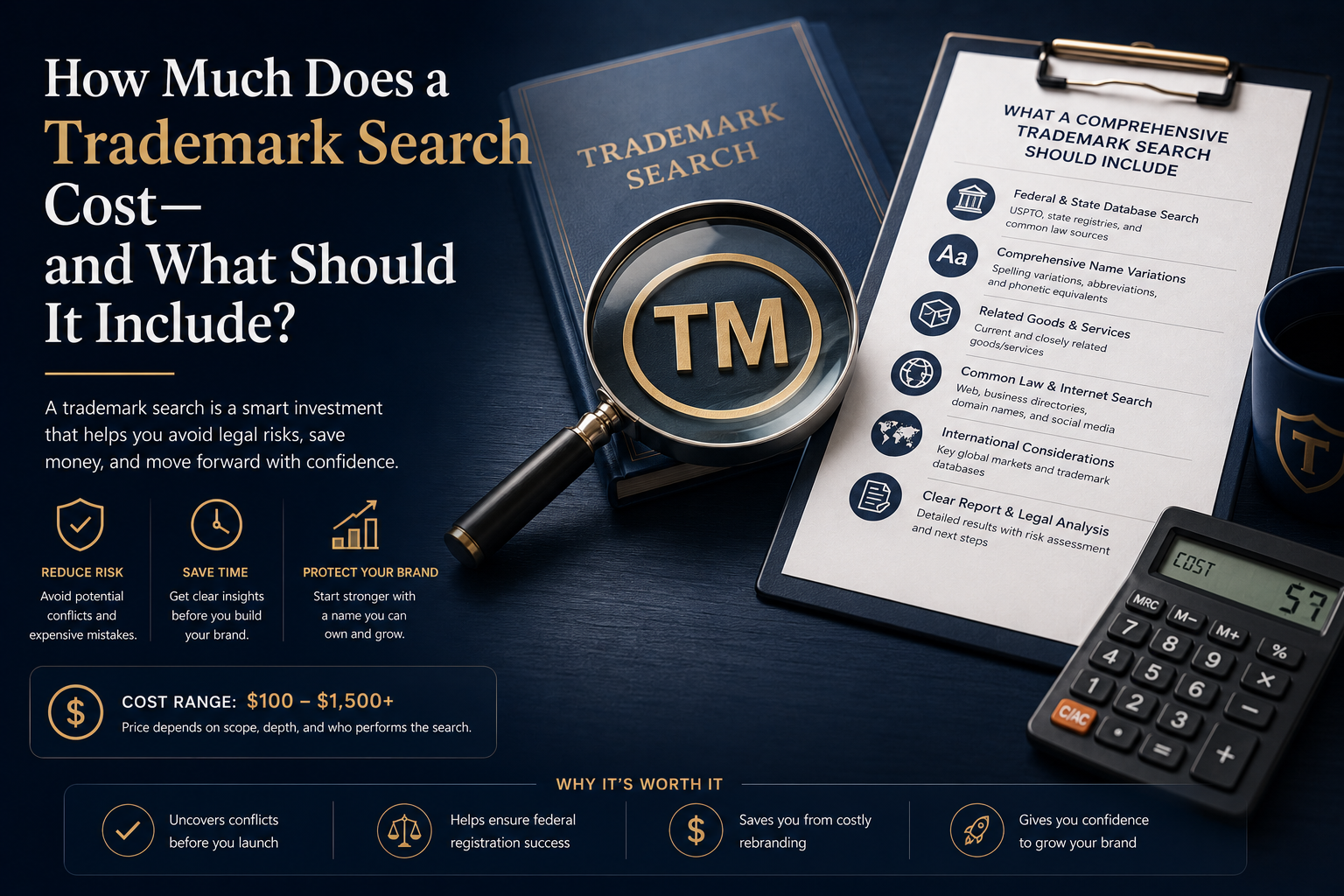
A trademark search can cost nothing, a few hundred dollars, or substantially more for complex international or multi-mark work. The price depends on what is searched and whether the result is a list of records or a legal assessment of risk.
The cheapest search is not necessarily poor, and the most expensive is not automatically comprehensive. The useful question is: will the search identify the conflicts that matter before you invest in filing and launch?
Free search versus clearance search
A free search of the USPTO database can identify obvious exact matches. It is an important first step, but it is not the same as a clearance analysis.
A proper review may examine:
- alternate spellings, spacing, plurals, and phonetic equivalents;
- similar appearance, sound, meaning, and commercial impression;
- translations and common abbreviations;
- related goods and services, including coordinated classes;
- live federal applications and registrations;
- relevant state, business-name, domain, marketplace, app-store, and common-law uses; and
- the strength, status, owner, and prosecution history of the most relevant records.
The deliverable should explain risk and options, not merely export hundreds of search results.
Three levels of trademark search
1. Preliminary or knockout search
This checks for immediate barriers such as identical marks for closely related goods or services. It is fast and useful for eliminating weak name candidates. It should not be treated as final clearance for a major launch.
2. U.S. clearance search
A broader U.S. search evaluates similar marks and relevant marketplace uses. The reviewer applies the likelihood-of-confusion factors to the important results and considers whether the proposed mark is descriptive or otherwise difficult to register.
3. International or portfolio search
Businesses launching in several countries may need national, regional, or international database work, local-language variants, and advice from counsel in relevant jurisdictions. The budget grows with the number of marks, classes, territories, and search depth.
What affects professional search cost?
- Number of proposed names or logos.
- Number and relationship of goods and services.
- Crowdedness of the industry.
- Word mark versus design mark.
- Common-law and marketplace scope.
- Number of countries.
- Urgency.
- Whether the fee includes a written registrability opinion and filing strategy.
A provider that checks one exact phrase in one database is selling a different service from a professional who analyzes similar marks, related fields, and marketplace use.
Why the search belongs before filing
The USPTO filing fee is not refunded simply because the mark is refused. More importantly, a conflict found after launch may affect packaging, domains, signage, product listings, investor documents, and advertising already tied to the name.
Search first when the brand will support inventory, paid acquisition, fundraising, marketplace enrollment, franchising, or licensing. A filing date is valuable, but filing a high-risk mark faster does not make it safer.
Questions to ask a search provider
- Is the search limited to exact matches?
- Does it cover confusingly similar marks and related goods or services?
- Are common-law and marketplace uses included?
- Will a licensed professional analyze the results?
- Is a written risk opinion included?
- Will the provider recommend changes or alternative filing strategies?
- Can the search fee be credited toward filing?
- What happens if the first-choice name is high risk?
Trademark Factory search options
Trademark Factory’s Single Search First currently costs $199. It is designed for a business committed to one first-choice brand and includes a trademarkability checkup for absolute grounds and conflicting marks. If the mark is suitable and the client proceeds, the client may upgrade to the Trademark Registration Package for $796 plus government fees, bringing the professional package total to $995.
The $995 Registration Package is intended for businesses ready to proceed and includes unlimited trademarkability checkups if alternatives are needed, followed by filing and registration guidance for a registrable option. Government fees are separate.
Verify current package terms on the pricing page before publication and whenever pricing changes.
The right search is a business decision
If the name is disposable and the launch is a small experiment, a preliminary search may match the risk. If the name will carry significant spend and goodwill, a professional clearance assessment is usually the more economical decision.
Start with a search before the cost of changing direction exceeds the cost of knowing.
Can I search a trademark for free?
Yes. USPTO search tools are free to use. A free search does not automatically include professional analysis or common-law research.
What is a comprehensive trademark search?
It evaluates more than exact matches and may include similar federal records, related goods and services, and relevant marketplace use, followed by a risk assessment.
Does a trademark search guarantee registration?
No. It reduces uncertainty but cannot control later filings, examiner judgment, third-party opposition, or undiscovered use.
Should I search before buying the domain?
Ideally, search before making substantial commitments. Domain availability does not establish trademark availability.
' width='400' height='200'/%3E%3C/svg%3E)