
This overview explains general IP concepts and identifies US and Canadian rules where they differ. Other countries may apply different requirements.
What Is Intellectual Property?
So let’s get started, first of all, intellectual property as a term is an umbrella term. It comprises completely different areas of law that vary in some very important aspects. So when you say “I own intellectual property,” it’s really meaningless unless you really understand what you own, right?
You can own a copyright in some things, you can own patents in certain other things, you can own trademarks in certain yet other things but when you just put everything out there well I own all IP, usually it means you probably don’t own anything because you don’t know what you’re talking about. So let's go through the different areas of intellectual property.
I'll explain what they cover, what things are important about them, and when to use those laws to protect certain aspects of the business of your creativity, okay?
So intellectual property as a whole is an umbrella term and it protects different aspects of human creativity. All types of intellectual property, in a nutshell, protect intangible results of human creativity. It’s just that those results are different so before I introduce the different types of intellectual property I just want to make a very short introduction that I like to use what’s called magic words for each of these types of intellectual property.
So basically one word that you should remember about each of these types of law so that you know exactly what protects what. So let's start with copyright, the magic word for that is “how?” Generally, copyright protects content for textbooks, it protects videos, it protects movies, it protects photographs and it protects software, it protects songs and multimedia.
Anything about content and when I say content, copyright doesn't protect the underlying ideas of your content, it doesn't protect the knowledge that you express in your content, it doesn't protect the skills that are required to create that content. It protects the content itself in the sense of how you were able to express that content. So for example, again my book, I wrote the book on intellectual property just because I wrote a book on intellectual property and it doesn't mean that nobody else can write another book on intellectual property.
Give Us an Example Andrei!
Copyright protects original expression rather than ideas, facts, or methods. In the United States, qualifying original work is protected once it is fixed in a tangible form, such as a document, recording, or digital file. Not every short sentence or phrase qualifies, and ownership can depend on employment, work-made-for-hire rules, and written transfers.
Reproducing a protected chapter or image may require permission, but copyright also has exceptions and limitations, including US fair use and Canadian fair dealing. Finding an image online does not establish a right to reuse it. For stock content, check that the actual licence covers your planned use, and retain a copy of the licence and purchase record. A paid licence does not guarantee that no dispute will arise.
Understanding Copyright
Copyright terms depend on the country, type of work, authorship, and relevant dates. For most US works created by an individual on or after January 1, 1978, the term is the author’s life plus 70 years. Different rules apply to works made for hire, anonymous or pseudonymous works, and older works.
Canada’s general term is the author’s life, the remainder of the year of death, and 70 further years. The extension that took effect on December 30, 2022 did not revive copyright that had already expired. Both countries have special categories and exceptions. Registration and enforcement requirements are separate questions from the duration or initial existence of copyright.
Understanding Trademarks
Now let’s go to trademarks and, as a founder of Trademark Factory, you may think that this is my favorite. Maybe it is. So trademarks a totally different beast, they are not about content! Trademarks are about identity which is why I always give them the magic word “which”. Imagine you are going to walk into a store and there is a shelf and on that shelf there are all sorts of different products with different brands but maybe there’s ketchup, ok so how different can ketchup be, right?
So here's one bottle, there’s the other bottle and both have ketchup in them, or shampoo or whatever I saw. So a trademark is that which allows me as a consumer to tell your ketchup apart from somebody else's ketchup or your shampoo from somebody else's shampoo, but it's not about functionality it's not about which ketchup is yummier, it's not about who's shampoo washes your hair better, it’s not about the result, it’s not about the features, it's not about the benefits, it's about identity.
How do I know that if I am shopping for Nike sneakers by Nike sneakers and not some other sneakers, right? That's the purpose of trademarks.
Trademarks identify commercial source: names, logos, and slogans can help customers distinguish particular goods or services. Their protection depends on the mark, the market, the territory, and the applicable law. It is possible for different owners to use similar words without infringement when the legal tests for conflict are not met.
Trademark rights can potentially continue indefinitely if the applicable use, renewal, and other legal requirements remain satisfied. In the United States and Canada, use may also support unregistered rights. Registration provides important advantages, but neither the availability nor the scope of unregistered protection is identical worldwide. Check the law of each market rather than assuming that an unregistered mark has no rights.
Understanding Patents
A patent can protect a qualifying invention. In the United States, utility patents can concern processes, machines, manufactured articles, or compositions of matter. A product claim and a process claim are types of patent claims, not the only two categories of patents. US law also provides for design and plant patents.
A patent gives its owner a right to exclude others from conduct covered by valid claims in the relevant territory. It is not a general permission for the owner to make or sell the invention: other patents and regulatory requirements may still matter. The claims, rather than a broad description of a product’s features, define the protected invention.
US utility patents generally have a term measured from the relevant nonprovisional filing date, usually 20 years, subject to applicable adjustments, extensions, and other rules. Required maintenance fees must be paid to keep a utility patent in force. Filing, examination, and enforcement costs vary. There is no universal five-to-six-year examination period or fixed fourteen-year period remaining after grant.
Patent protection generally requires disclosure of the invention. Once a particular patent expires, it no longer supplies an exclusive right under those claims, but other patents, trademarks, regulatory restrictions, and other legal rights may still apply. Check the current rules and processing information for the country and application type involved.
We Want More Examples Andrei!
For example, a medicine may involve patents covering an invention and a separate trademark identifying the source of the product. Expiry of one patent does not itself authorize every competing medicine or remove regulatory requirements. A competitor also cannot present its product as the trademark owner’s product. Truthful, non-deceptive references or comparisons may be permitted under applicable law; trademark ownership does not impose a universal ban on mentioning the brand.
Sum it Up, Andrei!
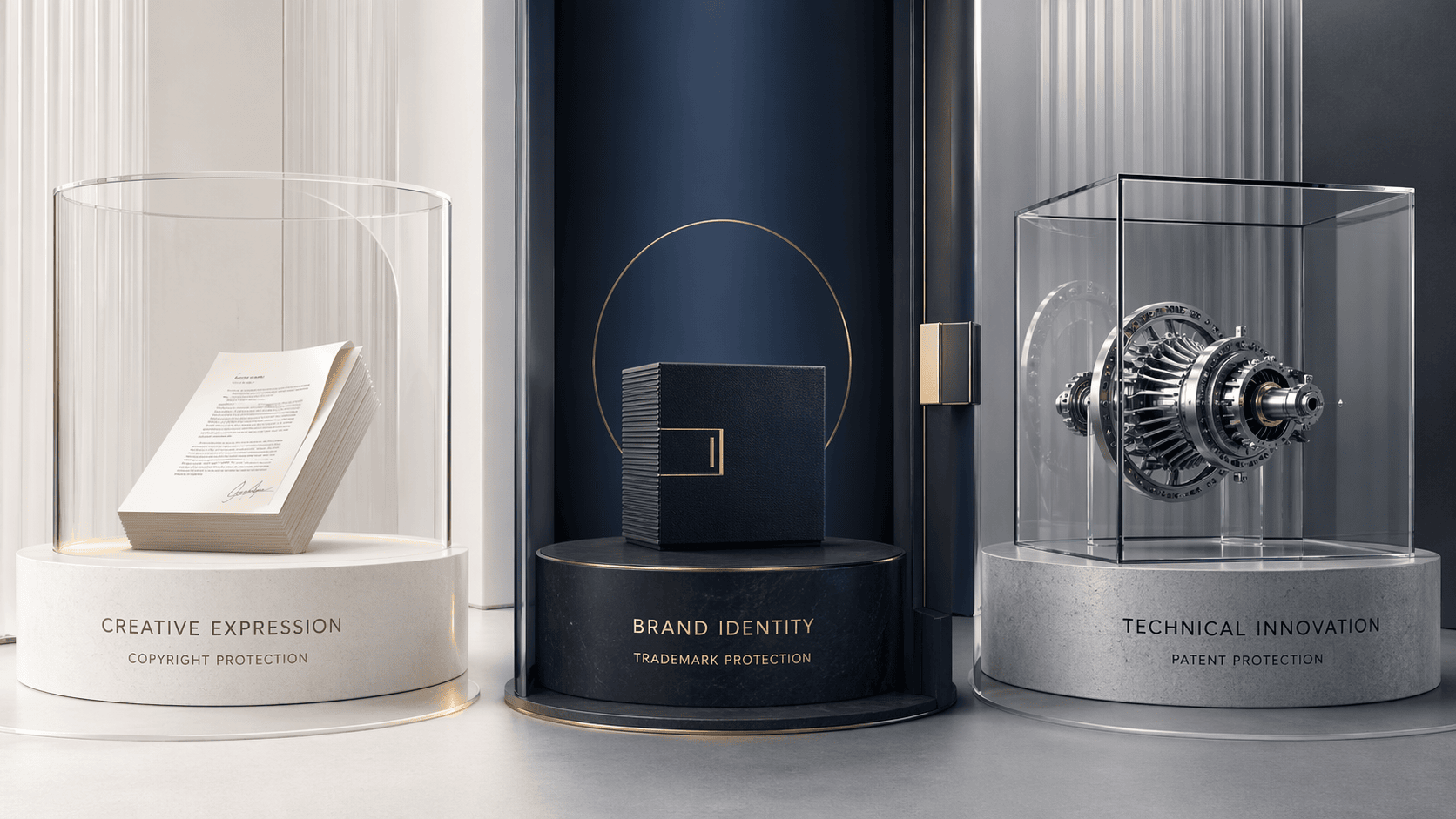
So again recap, Copyright content “how”, Trademarks “which”, Patents “what”.
Trade secret protection concerns information that has commercial value because it is secret and is subject to reasonable measures to preserve that secrecy. It can last while the requirements remain satisfied. It does not generally prevent another party from developing the same information independently or obtaining it by lawful reverse engineering. Independent discovery by one party does not necessarily make the information public or erase every other holder’s rights.
Understanding NDAs
A nondisclosure agreement can support confidentiality, but it is not the only safeguard and it is not a guarantee. Limit access to people who need the information, use appropriate security measures, train staff, and define permitted uses and disclosure obligations. These measures have real costs. Whether a particular agreement or disclosure preserves protection depends on the facts and applicable law.
Understanding Design Patents
Design protection concerns appearance rather than the technical operation of an invention. A US design patent protects a qualifying ornamental design for an article of manufacture. For US design applications filed on or after May 13, 2015, the patent term is 15 years from grant; earlier applications follow the previous 14-year term. Certain screen-displayed designs can qualify, so this should not be reduced to a rule about physical product shapes alone.
In Canada, a registered industrial design protects qualifying visual features. Under the current system, protection ends at the later of 10 years from registration and 15 years from the Canadian filing date, provided the required maintenance fee is paid. Earlier registrations may be subject to transitional rules. Novelty and other requirements must be assessed under the applicable law; seeing a design abroad does not make it available to claim as your own.
The Recap
So that's the five types of intellectual property in a nutshell. Copyright “how”, protects content. Trademarks “which”, protect brands. Patents “what”, protect the substance of your invention. “Hush” for Trade secrets, protect your confidential information. And then “wow” design patents or industrial designs that protect the looks of your physical products to the extent there is something unique about them. And there's another one that I always end with which is intellectual property contracts.
Contracts can define ownership, licences, confidentiality, and obligations between the parties. They do not automatically create patent, copyright, or trademark rights enforceable against everyone, and their effect depends on the law and the terms agreed. Review ownership and permitted uses before signing an IP agreement.
So that’s what contracts can do and also similarly contracts can destroy rights, so you may be the original author of a book or original author of a song but if you sign a contract whereby you transfer that copyright over to somebody else well that’s it! You no longer own it, they do! So be very careful what documents you sign, what contracts you sign, and make sure that if you’re using somebody else’s work, somebody else’s IP, that you get them to sign whatever paperwork needed for you to be able to safely enjoy all of that!
Now, I hope that this little introduction to intellectual property is useful for you. Quick recap, Copyright “how”, protects content. Trademarks “which”, protect brands. Patents “what”, protect inventions. “Hush” for Trade secrets, protect confidential information. “Wow” for industrial design or design patents that protect the looks of physical products. And I didn’t tell you this, the magic word for Contract is “whatever” because you can create whatever you want to the contract.
So with this, I believe that you’re well-equipped to look at any situation that your business may be facing and decide what you need to do to protect your assets. If you’re writing content or if you’re having your own content well you know that it’s protected automatically, you don’t have to register anything–it sometimes may be good addition but it wouldn’t affect the ownership. And you know that you shouldn’t use other people’s content without their permission.
You also know that if you came up with a revolutionary idea, a new product, or a new method of doing something, well there are really two avenues. You can try to get a patent and know that it’ll be a very long process that’s gonna cost you a lot of money and even if you succeed you only gonna have a few years to enforce that monopoly. Or you could go the trade secrets route.
Don’t get a patent, don’t spend that money. I would say if you can protect your invention other than through the patents, don’t get the patent. Just go through the know-how, just go through the trade secrets, right? That’s the posh part! And make sure that you protect your brand because the brand can live forever. The brand can live on and on and on and nothing else is proprietary about your business, you can still rely on your brand to tell people why they should go and buy from you versus somebody else.
' width='400' height='200'/%3E%3C/svg%3E)