
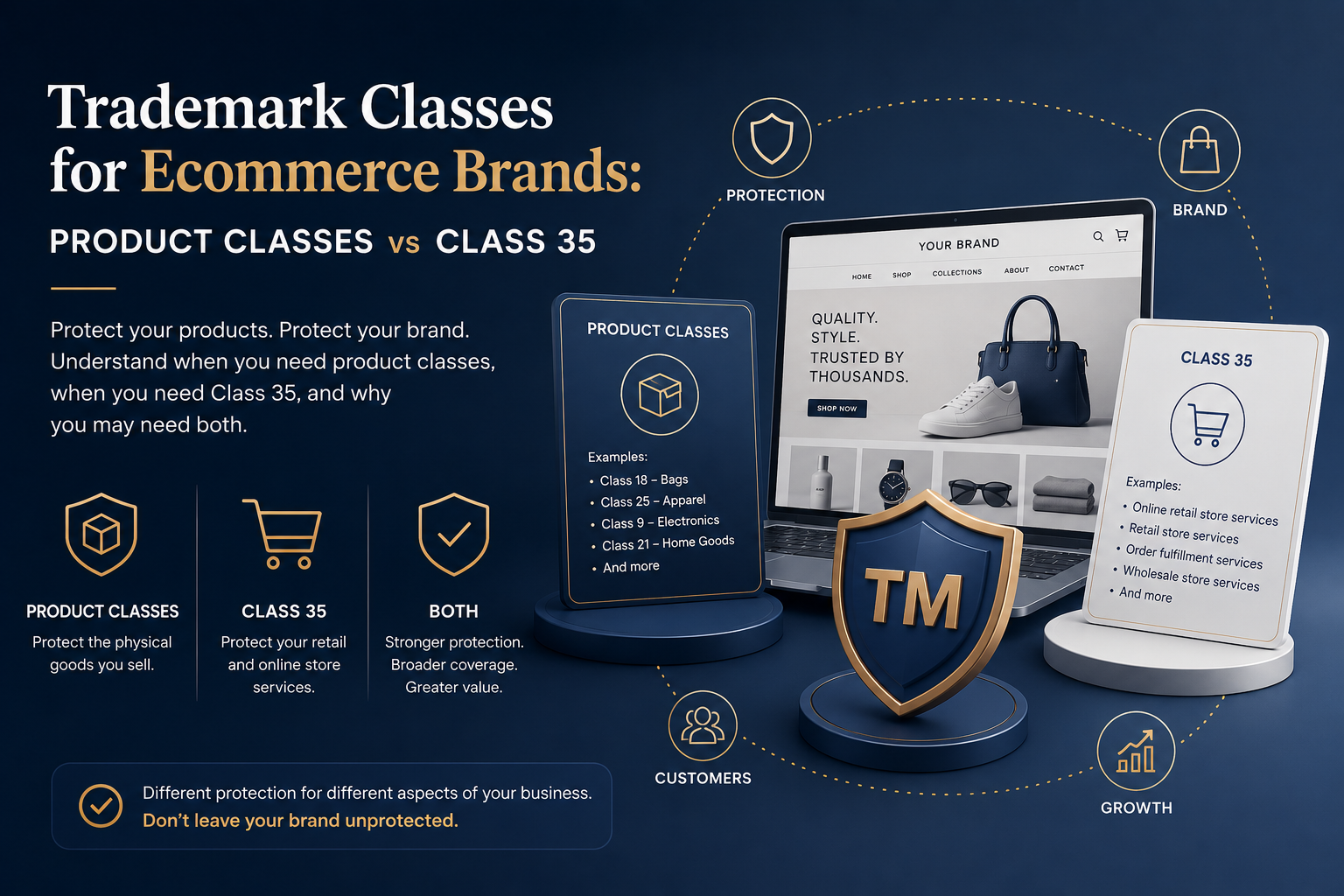
An ecommerce brand does not automatically belong in Class 35. The correct filing depends on what the trademark identifies: your own products, a retail store service, a marketplace, or a combination of these.
This distinction affects both protection and cost. Government fees are charged per class, and choosing only Class 35 may leave a private-label product brand without direct coverage for its goods. Filing every possible product class, however, can waste money and create evidence obligations the business cannot satisfy.
The quick decision rule
If the mark appears on your own products, prioritize the classes for those products. Skincare may involve Class 3, clothing Class 25, bags Class 18, drinkware Class 21, and supplements Class 5.
If the mark identifies an online store, boutique, or marketplace service, Class 35 may be relevant. A retailer that sells multiple brands under a store name is using that name differently from a private-label brand placed on one product line.
Many businesses do both and may need both types of coverage.
What product classes protect
Product classes cover the goods sold under the mark. If NORTHPINE appears on jackets, backpacks, and water bottles, the business should evaluate the classes for those goods—not merely the fact that the products are sold online.
Product protection matters for private-label sellers because customers encounter the mark as the brand of the item. A Class 35 retail-services filing does not simply replace the product classes.
Start with the goods that create current or near-term revenue. Grouping should follow the official classification, not a marketing category such as “lifestyle products.”
What Class 35 protects
Class 35 includes retail and online retail store services, marketplace services, advertising, and certain business services. Retail identifications should normally state the field or the goods featured by the store.
Class 35 becomes more important when:
- the store name itself is a customer-facing brand;
- the business sells goods from multiple manufacturers or brands;
- the company operates a marketplace connecting buyers and sellers;
- the retail concept may expand across product categories; or
- customers recognize the mark as the destination where they shop, not only the label on one product.
Merely having a Shopify site or Amazon storefront does not automatically mean Class 35 is the first priority.
Four ecommerce models
Private-label product brand
If your mark appears on your own coffee mugs, the product class is the core. Class 35 may be secondary if the same mark also functions as a distinct retail-store brand.
Curated boutique
A boutique selling products from several designers under its store name is providing retail services. Class 35 is often central. If the boutique also sells its own clothing line, Class 25 may be needed for that line.
Marketplace platform
A platform that brings together third-party sellers and buyers often needs Class 35 for online marketplace services. Downloadable apps, SaaS tools, payment services, logistics, or education may add other classes depending on the offering.
Amazon private-label seller
An Amazon seller placing its mark on its own goods should begin with the applicable product class. Marketplace eligibility rules and trademark law are related but not identical; do not choose Class 35 solely because sales occur through Amazon.
How many classes should you file?
Use a revenue-and-risk map:
- List goods currently sold under the mark.
- List goods with a documented near-term launch plan.
- Identify whether the store name itself is a separate consumer-facing service brand.
- Separate marketplace, subscription, education, software, and other services.
- Estimate the government fee and later specimen burden for each class.
- Search identical and related classes before filing.
The current USPTO base filing fee is $350 per class when the application meets the base requirements. Two classes therefore start at $700 in government application fees; professional fees and later intent-to-use fees are separate.
Specimens for products and online stores
For goods, acceptable evidence can include the mark on the product, packaging, an attached label, or a point-of-sale webpage showing the goods, the mark, and purchasing information.
For online retail services, the evidence should show the mark and the retail service—such as a branded storefront offering the specified goods. A product photo bearing the mark may prove use for the product but not necessarily for a separate retail service.
Webpage specimens need a URL and access date. Keep uncropped captures and records of the live page.
Common ecommerce filing mistakes
- Filing only Class 35 for a private-label product brand.
- Filing only product classes when the store or marketplace name is a valuable separate brand.
- Listing every product that might someday be sold.
- Assuming one broad “ecommerce” identification covers all activity.
- Searching only exact matches in the same class.
- Using a store screenshot as evidence without clearly showing the specified retail services.
- Allowing a supplier, founder, or holding company mismatch to create an ownership problem.
Build protection around the actual business model
The right class plan should mirror how the customer experiences the brand and where the business is headed next. It should protect core revenue without turning the application into an expensive wish list.
Trademark Factory can assess the mark, search related product and retail fields, and create a filing strategy for private-label brands, boutiques, and marketplaces. Start before ordering large inventory or committing to marketplace launch materials.
Do all online stores need Class 35?
No. Class 35 may protect retail or marketplace services, but a private-label seller should also evaluate the classes for its goods.
Does Class 35 protect the products I sell?
It protects specified services, not every product offered through the store. Product classes may be needed when the mark brands the goods themselves.
Can one trademark application include several classes?
Yes. One application can list multiple classes, with government fees generally charged per class and evidence requirements applying to each use-based class.
What class does an Amazon seller need?
It depends on the goods and whether the mark identifies a separate store or marketplace service. Selling on Amazon alone does not determine the class.
' width='400' height='200'/%3E%3C/svg%3E)