
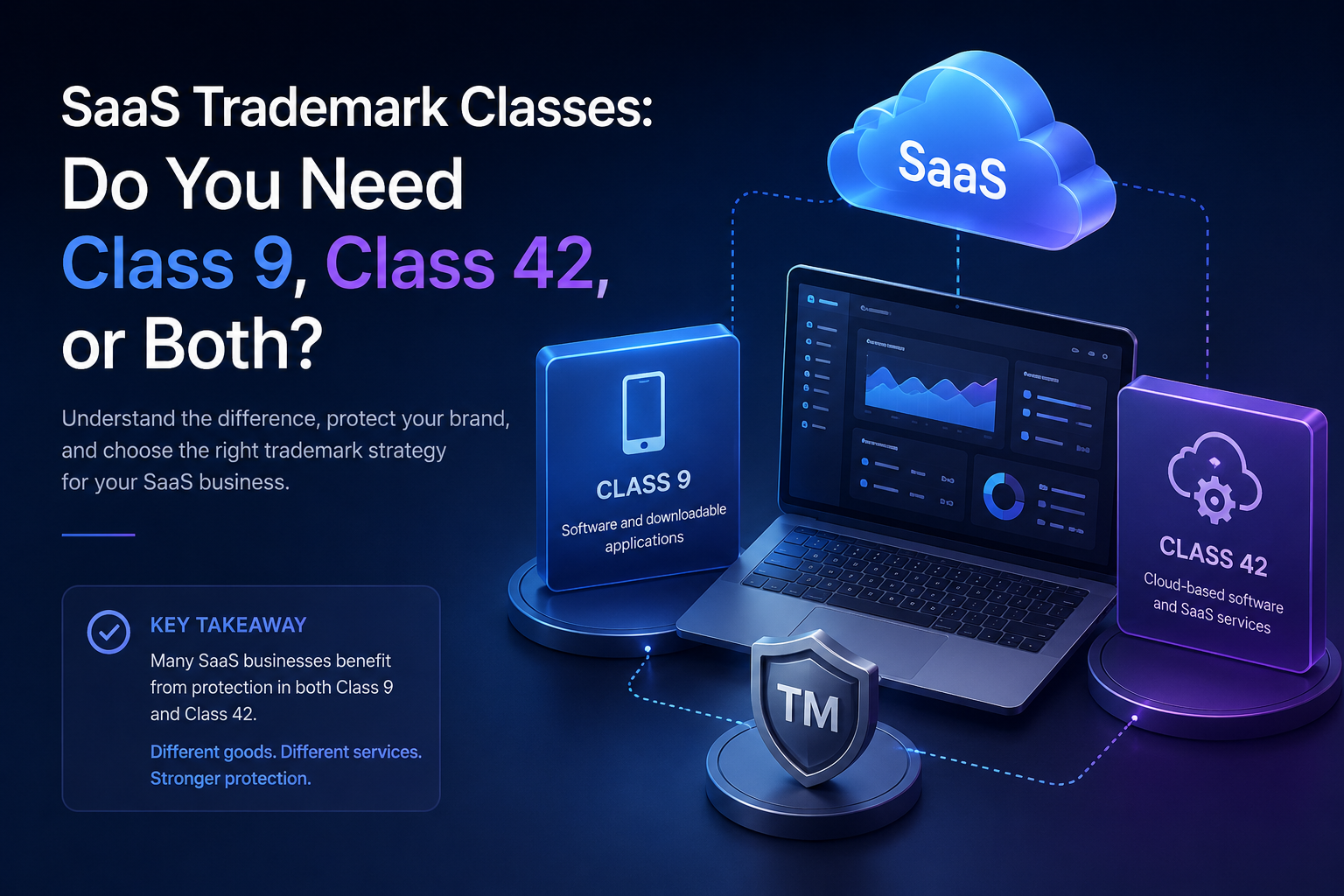
Software founders often assume that every technology brand belongs in one “software class.” The USPTO classification system does not work that way. Downloadable software is commonly classified in Class 9, while providing temporary use of online, non-downloadable software—software as a service—is generally in Class 42. The function of the software and any separate business service can add other classes.
Choosing correctly matters because government fees are charged per class and an application cannot be expanded later to cover goods or services that were omitted. The goal is not to buy every class that mentions technology. It is to protect the way customers actually receive and use your product, plus the expansion that is supported by a real business plan.
The short answer
Use Class 9 when customers download software, such as a mobile application, desktop program, plugin, or downloadable digital product.
Use Class 42 when customers access software online without downloading the core software, such as a hosted analytics platform, cloud CRM, online design tool, or other SaaS product.
Some products need both. A SaaS platform may have a downloadable mobile app in Class 9 and a hosted software platform in Class 42. The identification must state the software’s function; “software” alone is usually not sufficiently specific.
What Class 9 covers
Class 9 covers goods, including downloadable computer software and downloadable mobile applications. The application should identify what the software does or its field of use.
Examples include:
- downloadable software for managing customer relationships;
- downloadable mobile applications for personal budgeting;
- downloadable plugins for editing digital images; and
- recorded computer software for inventory management.
The exact wording must match the product. A founder should not copy a competitor’s identification without checking the delivery model and function.
What Class 42 covers
Class 42 includes technology services such as software as a service, platform as a service, hosting, and certain software design and development services. A typical SaaS identification states that the applicant provides temporary use of online, non-downloadable software and specifies the function.
Examples include:
- software as a service featuring software for project management;
- providing temporary use of online, non-downloadable software for fraud detection;
- platform as a service featuring computer software platforms for ecommerce inventory management; and
- design and development of computer software for others.
The last example is a development service performed for clients. It is not the same as selling access to your own SaaS platform.
When a SaaS company may need other classes
Classification follows the actual goods and services, not the company’s industry label. A platform may also provide:
- Class 35 advertising, business consulting, or online marketplace services;
- Class 36 payment processing or financial services;
- Class 38 telecommunications or communications transmission;
- Class 41 education or training; or
- another class tied to the regulated or operational service delivered through the software.
For example, software used to schedule fitness classes may be in Class 42, while actually providing fitness instruction is a Class 41 service. A fintech dashboard may be software in Class 42, but a separate payment-processing service can involve Class 36.
Do not claim the underlying professional service merely because the software helps customers perform it. Determine who performs the service and what customers purchase from your company.
Do you need both Class 9 and Class 42?
Consider both when the brand is used for a meaningful downloadable product and a hosted platform. A thin companion app that only provides access to the hosted service still requires careful analysis; filing both classes is not automatic.
Ask:
- Can a customer download executable software under the mark?
- Does the customer receive continuing access to hosted, non-downloadable software?
- Is the same mark used for both offerings?
- Can you provide an acceptable specimen for each use-based class?
- Are both products in the launch plan, or is one only hypothetical?
An intent-to-use filing can preserve a filing date for a genuine planned offering, but you will later need evidence of real use and additional per-class filings.
Specimens for software and SaaS
For downloadable software, a specimen may show the mark on a download page or in an app marketplace where users can obtain the software. It should connect the mark to the downloadable product and include the required webpage URL and access date.
For SaaS, a webpage may work when it displays the mark and clearly offers the identified online, non-downloadable software service. A login screen alone can be weak if it does not explain the service. Capture enough context to connect the mark with the function listed in the application.
Common filing mistakes
- Filing Class 9 simply because the company is a “software company.”
- Describing the product only as “computer software.”
- Filing Class 42 for downloadable software without a hosted service.
- Claiming business or financial services that the software only helps customers perform.
- Filing too narrowly around the first feature and leaving no room for the actual roadmap.
- Filing too broadly without a bona fide plan or evidence.
- Using different brand versions in the application, app store, and SaaS website.
A practical filing strategy
Map the customer journey before selecting classes. List what the user downloads, what runs on your servers, what human services your company performs, and how each offering is described on the website and in contracts. Then search the mark across identical and related technology goods and services, not only the class number.
Trademark classes organize filings, but they do not create walls between confusingly related products. A similar mark in a coordinated or commercially related class can still create a problem.
Protect the brand before launch costs compound
Changing a SaaS name after product development, domain acquisition, paid acquisition, app-store reviews, and fundraising is expensive. A registrability assessment before launch can identify conflicts and help align the application with the actual delivery model.
Trademark Factory can assess the proposed mark, map the relevant classes, and prepare an attorney-led filing for your software roadmap. Start with a search if the name is fixed, or the registration package if you are ready to move forward.
Is SaaS always Class 42?
Hosted, non-downloadable software is generally in Class 42, but a SaaS business may also offer downloadable software or separate services in other classes.
Is a mobile app Class 9?
A downloadable mobile application is commonly in Class 9. The identification should state its function.
Can I add Class 9 later to a Class 42 application?
You generally cannot broaden an existing application to add omitted goods or services. A separate application may be necessary.
Should I file my company name or product name?
Protect the marks that customers use to identify the source of your goods or services. A company name and a product name can require separate applications if both function as marks.
' width='400' height='200'/%3E%3C/svg%3E)