
What is a Generic Trademark? What Are Descriptive, Suggestive, Arbitrary, and Fanciful Trademarks?
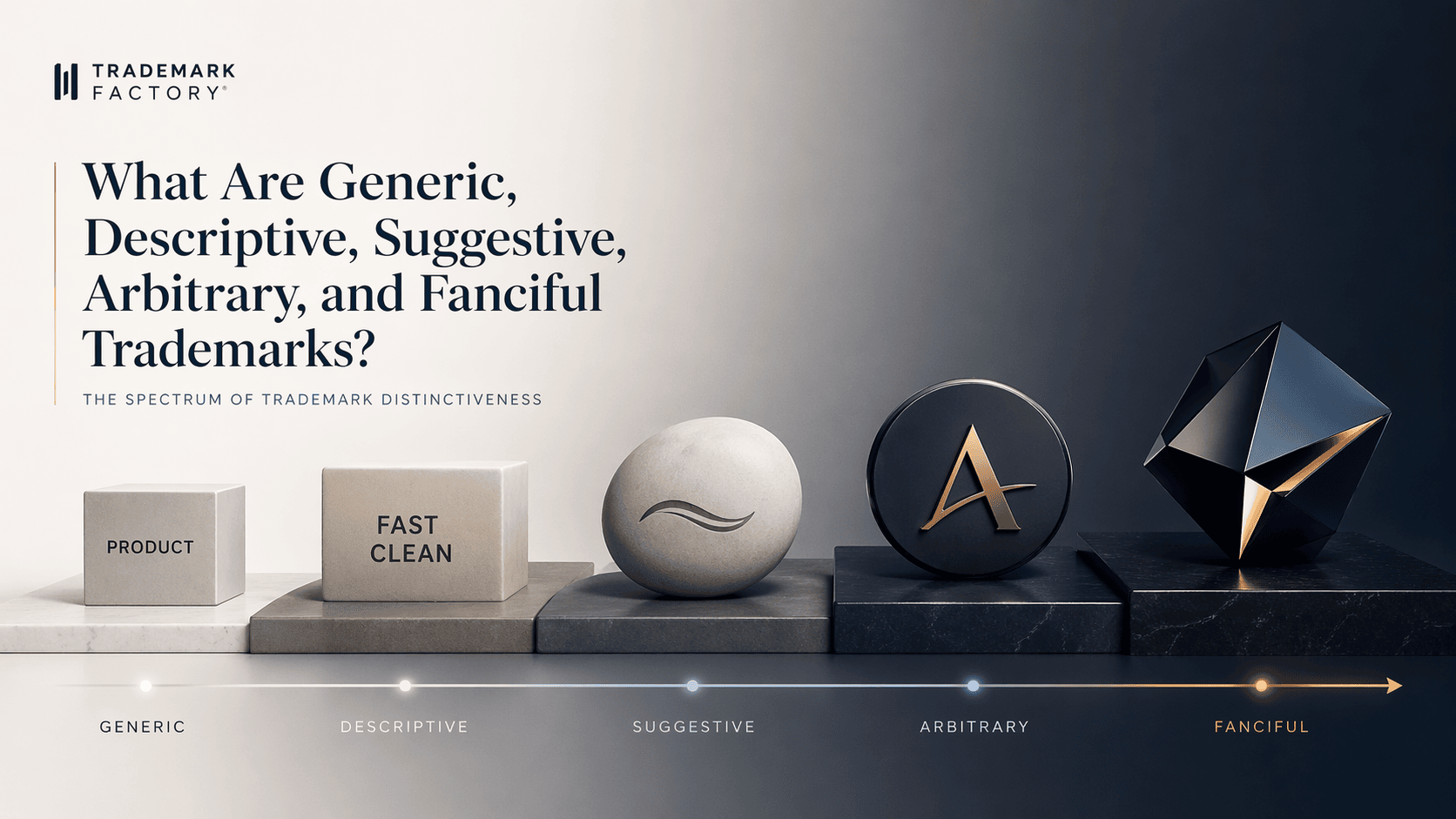
Not all brands are created equal. Some brand names are inherently stronger than others. That depends on where your brand is on the spectrum of distinctiveness—going from generic, descriptive to suggestive, arbitrary, and fanciful marks.
Watch this video to understand the principles behind distinctiveness better so you can pick a strong brand for your new product or service or evaluate whether your current brand is inherently strong.
As you will see, the strongest trademarks may not always be the most obvious or descriptive ones. Nevertheless, registering a trademark always helps to have something distinctive to set you apart.
I'm Andrei Mincov, the founder of Trademark Factory, and in this video, I'm going to walk you through the spectrum of distinctiveness for trademarks.
Explaining Trademark Distinctiveness
I will explain the general principles and then give examples of two fictitious products and services. There are five buckets on the spectrum of distinctiveness that your brand and trademark can fall into. The Trademarks Office would need to decide which buckets best fit you to treat your trademark legally.
Generic Trademark
Spoiler alert: there are buckets you NEVER want your trademark to fall into. OK. The first bucket is GENERIC trademarks. This is the weakest form of a brand. In most cases, it's not a brand AT ALL. It's just a common name everyone uses for the particular product or service you offer. You cannot trademark brands that are generic because if you were allowed to own a monopoly over a generic name, it would mean that nobody else could sell versions of the same product or service—simply because, to do so, they'd have to stop calling their products and services what they are.
For example, if you sell ice cream, you can't go and trademark the term "ICE CREAM." You can't trademark the word "BICYCLE" if you sell bicycles. If you are a fitness trainer, you can't trademark the phrase "FITNESS TRAINER." And so on.
A brand name can lose trademark significance for particular goods or services if the relevant public comes to understand it primarily as the generic name of the product or service rather than as a source identifier. That question is specific to the relevant goods or services, public, territory, and evidence. It cannot be answered by treating a worldwide list of familiar words as universally unprotected.
Using a brand name as a verb does not, by itself, prove that it has become generic. In Elliott v. Google, the US Court of Appeals for the Ninth Circuit rejected the proposed genericness claim on the record before it. This was an appellate court decision, not a Supreme Court ruling that every use of the word was protected. Do not assume that familiar names such as Google or Kleenex have lost trademark rights.
Descriptive Trademark
The second bucket is for CLEARLY DESCRIPTIVE marks. These marks are a step up from generic marks in that they no longer use the common word for the product or service itself. Instead, they use words that do nothing but clearly describe a feature or characteristic of the product or service. For example, you can't trademark the term "COLOR" if you sell printers. Likewise, if you sell legal services, you can't trademark "FLAT FEE."
In most countries, you would not be able to trademark descriptive marks. However, in the U.S., you may be able to trademark your descriptive trademark on the Supplemental Register. We have a video about the Supplemental Register.
The reason the Trademarks Office does not like descriptive trademarks is that if you were allowed to own a monopoly over such marks, it would mean that nobody else could sell their versions of products or services with the same features or characteristics—simply because to do so, they'd have to stop referring to these features and attributes by their common names. This can create confusion and unnecessary roadblocks for competitors.
The crucial difference between generic and descriptive brands is that with clearly descriptive brands, in addition to possibly being able to get them registered on the Supplemental Register in the U.S., you can get them registered on Principal Register in the U.S. and just written everywhere IF you can prove that your brand has acquired distinctiveness. This means that you can prove that most people in the market for your products or services, when they hear or see your brand think of YOUR products and services, not just ANY products or services with the same features.
Here are some examples of clearly descriptive marks that acquired distinctiveness: NATIONAL CAR RENTAL, KENTUCKY FRIED CHICKEN, AMERICAN AIRLINES, PAYLESS SHOES. Initially, these names are descriptive, but because of their market reach, they became proper trademarks for their owners.
A quick tip: proving that your descriptive mark has acquired distinctiveness could be very difficult and expensive. And with more and more trademarks being filed worldwide every year, it's getting more and more challenging to get to that level. This means it’s usually better to try to have a more distinctive trademark.
Suggestive Trademark
The third bucked is for a SUGGESTIVE trademark. They are a step up from descriptive marks. They ALLUDE to features and characteristics of your products and services but in a much more subtle way. Here are just a few examples of suggestive patterns: "BED, BATH & BEYOND," "PHOTOSHOP", "SCANSNAP," and "QUICKBOOKS."
You can sort of figure out WHY they chose that particular name, but it's not like having this specific name limits the freedom of their competitors to sell their products and services—as long as they use different words. And it's precise because they don't limit their competitors' freedom; suggestive marks are trademarkable.
So here's the kicker. Sometimes, the line between clearly descriptive and suggestive marks is very murky. It often boils down to an argument between you and the Trademarks Office. It is often subjective and inconsistent. Trademark Factory is a great example. We got the TRADEMARK FACTORY trademarked in Canada, the US, European Union, Brazil, Mexico, Russia, and New Zealand. In contrast, China and India refused registration as they thought the mark was descriptive.
Arbitrary Trademark
An arbitrary mark uses an existing word in a way that does not describe or suggest the relevant goods or services. The same word can be generic for one product and arbitrary for another. The USPTO uses APPLE for computers as an example: the ordinary fruit word does not describe those goods.
Assess the actual word and the actual goods or services. An arbitrary classification concerns inherent distinctiveness; it does not guarantee availability, registration, or freedom from earlier rights.
Fanciful Trademark
A fanciful mark is a coined term created to function as a brand rather than an ordinary word describing the goods or services. The USPTO gives EXXON for petroleum and PEPSI for soft drinks as examples. A familiar company name is not automatically fanciful, and an ordinary word does not become an invented word simply because a company adopts it.
Fanciful marks are inherently distinctive, but applicants must still meet other registration requirements and address potentially conflicting earlier rights. Avoid classifying a list of famous brands without checking each term’s origin, meaning, and use.
Trademark Distinctiveness Is Not Always Exact
So these are the five main buckets but know that many marks live between the suggestive, arbitrary, and fanciful buckets. They may not be completely random or fanciful, but it's not that they necessarily point to a feature or a characteristic of products and services. YouTube, Hewlett-Packard, Smith & Wesson, DreamWorks, and Uni-Ball are good examples.
We have the five buckets to make it easier for businesses (and trademark attorneys) to identify which of the buckets your brand is closer to. But many trademarks have a similar argument to be in several buckets. I hope this makes sense. So before we finish this off, let me give you two situations.
Hypothetical Scenario #1: Pencils
Let's say you make pencils. Right, your business is you make and sell pencils. So a generic name for your products would be... PENCIL.
A descriptive name for your products would be... SHARP or ALWAYS SHARP or something like that. A suggestive name could be DRAWSTIX with an X at the end. You see, misspelling a name doesn't make it fanciful. It's still examined as if it was correctly spelled. An arbitrary name for your pencils could be "PIZZA." Or "HELICOPTER." Or "BANANA."
An example of a fanciful name for your pencils could be BELLION, QRSTPUV, or GRX27.
Hypothetical Scenario #2: Accounting Firm
Or here's the second situation. You run an accounting firm. A generic name would be... ACCOUNTING. A descriptive term would be ON-TIME ACCOUNTING, or simply ON-TIME. A suggestive name could be COUNTING BEANS or COUNTING BEANS ACCOUNTING SERVICES. Finally, an arbitrary name for accounting services could be PIZZA ACCOUNTING, ZEBRA ACCOUNTANTS, or LIPSTICK CHARTERED ACCOUNTANTS.
Adding the word "accounting" or "accountants" doesn't change the nature of the mark because it would be a part of the mark you'd have to disclaim anyway since it's a generic word for the services you offer. So the only factors that remain, Pizza, Zebra, or Lipstick, in this case, are arbitrary since they have nothing to do with accounting services.
And finally, fanciful names for accounting services could be Colang, Tremulbite, or Bonkoto ACCOUNTING. Again, these words mean nothing except that they are supposed to identify your brand.
From a distinctive name to a clearance decision
A name can be inherently distinctive and still conflict with an earlier mark. Use the spectrum above to assess the name’s strength, then use a clearance search to investigate whether it is a workable choice for your intended business.
- Define the use before judging the name. Write down the goods or services and intended markets beside each candidate. A word’s trademark significance depends on that context.
- Screen a shortlist before investing in one option. Use a preliminary search to identify obvious obstacles. Do not treat the absence of an exact match as clearance.
- Investigate the remaining candidates. Follow the trademark search guide for a broader review of official records and relevant marketplace use. Assess close findings in context rather than ranking names by the number of search results.
- Resolve the important questions before launch. Similarity can involve sound, appearance, meaning and related goods or services. Our guide to look-alike and sound-alike trademarks explains why a spelling change may not solve a conflict. Obtain advice on unresolved risks before paying for a rollout that would be costly to reverse.
Keep a decision record with the selected name, goods or services, territories, search date, significant findings and unresolved questions. Repeat the relevant review if the name, offering or intended market changes. This process supports a better-informed decision; it does not guarantee registration or freedom from a dispute.
Recap: Trademark Distinctiveness
So once again, the final summary. Generic marks are impossible to trademark. Descriptive marks are difficult to trademark; if you get one, you will have a hard time enforcing it against your competitors since descriptive spots are inherently weak. Suggestive effects are doable, but often you need to work on convincing the Trademarks Office that your print is suggestive rather than descriptive.
Arbitrary and fanciful marks are inherently distinctive, which can make them stronger choices, but classification alone does not guarantee registration or the outcome of enforcement. So if you're just trying to develop a new brand for your business, your products, or services, have that in mind. Get a brand you can own. Get a brand you can trademark. And if you're serious about protecting your brand, use Trademark Factory® to help you register it as a trademark.
First, we will prepare a registrability opinion based on whether your trademark is distinctive enough and whether there are any other previously filed or registered trademarks that would stand in your way. Suppose we find any concerns with your first choice.
In that case, you can always get a full refund or do what most of our clients do in these situations: you can keep sending us, at no extra charge, your other ideas for the brands you have in mind until you pick a brand you love that we tell you is trademarkable.
So again, if you're serious about owning your brand, use Trademark Factory. We're the only firm in the world that will help you trademark your brand with a guaranteed result for a guaranteed budget without wasting your time and money on trademarks that don't go through.
Follow our YouTube channel or newsletter for more information. Or get in touch with one of our Trademark strategists to file your trademark successfully.
' width='400' height='200'/%3E%3C/svg%3E)