

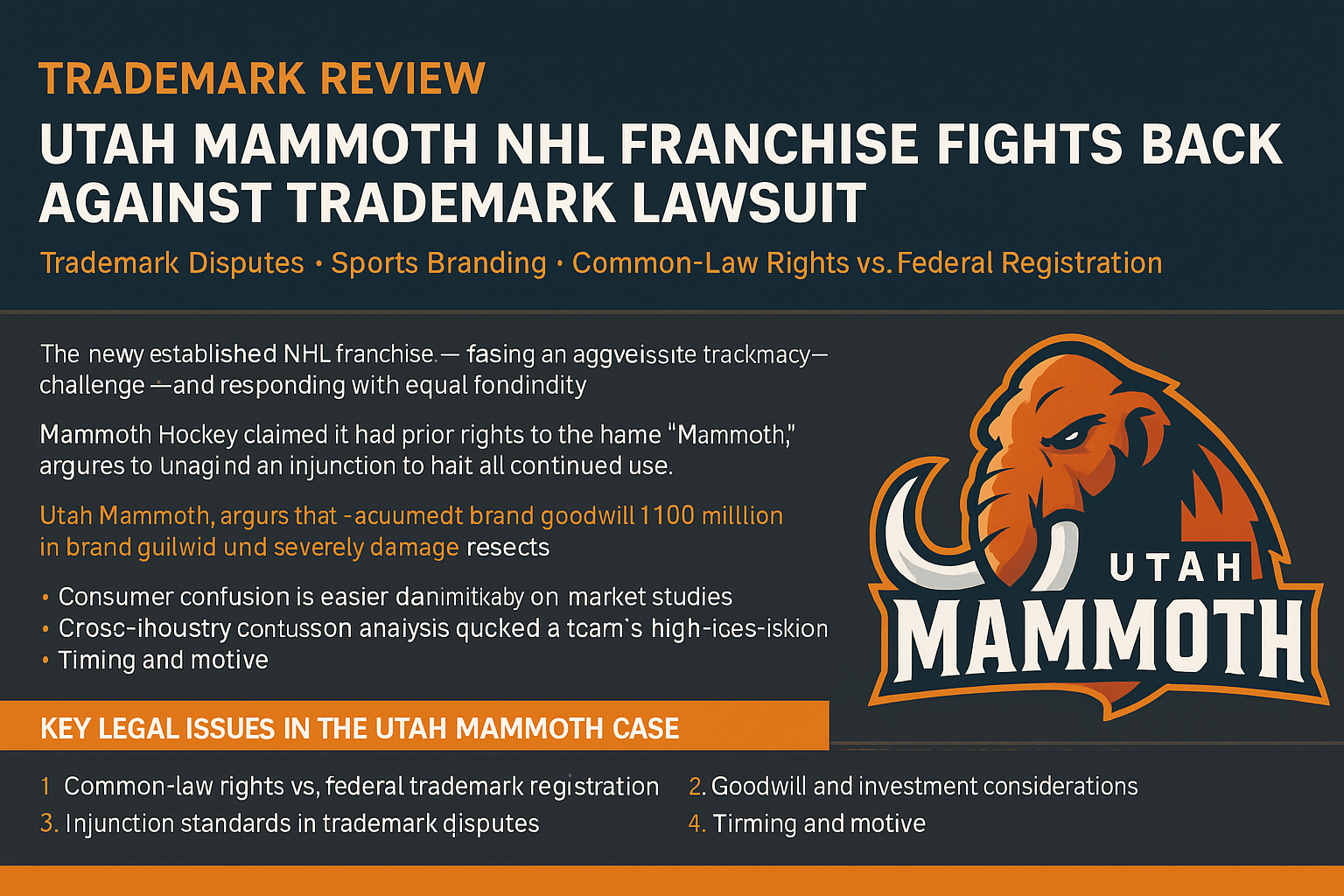
After investing roughly $7 million into building its brand identity, including uniforms, digital media, merchandise, mascot development, and promotional campaigns, the team saw immediate market success. Fans across the U.S. embraced the branding, generating nearly $500,000 in merchandise sales within months of launch. But that momentum is now threatened by a lawsuit filed by Mammoth Hockey LLC, an Oregon-based seller of premium hockey bags. The company claims that the NHL team’s name and mammoth-head logo infringe its rights and has requested an injunction to halt all continued use.
Utah Mammoth, however, argues that:
- the team has already accumulated over $100 million in brand goodwill,
- rebranding at this stage would severely damage licensing, sponsorship, and fan relations,
- consumer confusion is minimal based on market studies,
- the geographic designation “Utah” clearly distinguishes the identities,
- and the timing of the lawsuit suggests the plaintiff sought maximum visibility during the NHL season.
The case underscores a recurring IP theme:
👉 trademark disputes are significantly more complex and costly when businesses wait too long to secure rights.
This isn’t just a legal battle — it’s a clash between a rising national sports brand and a small business relying on unregistered, common-law rights.
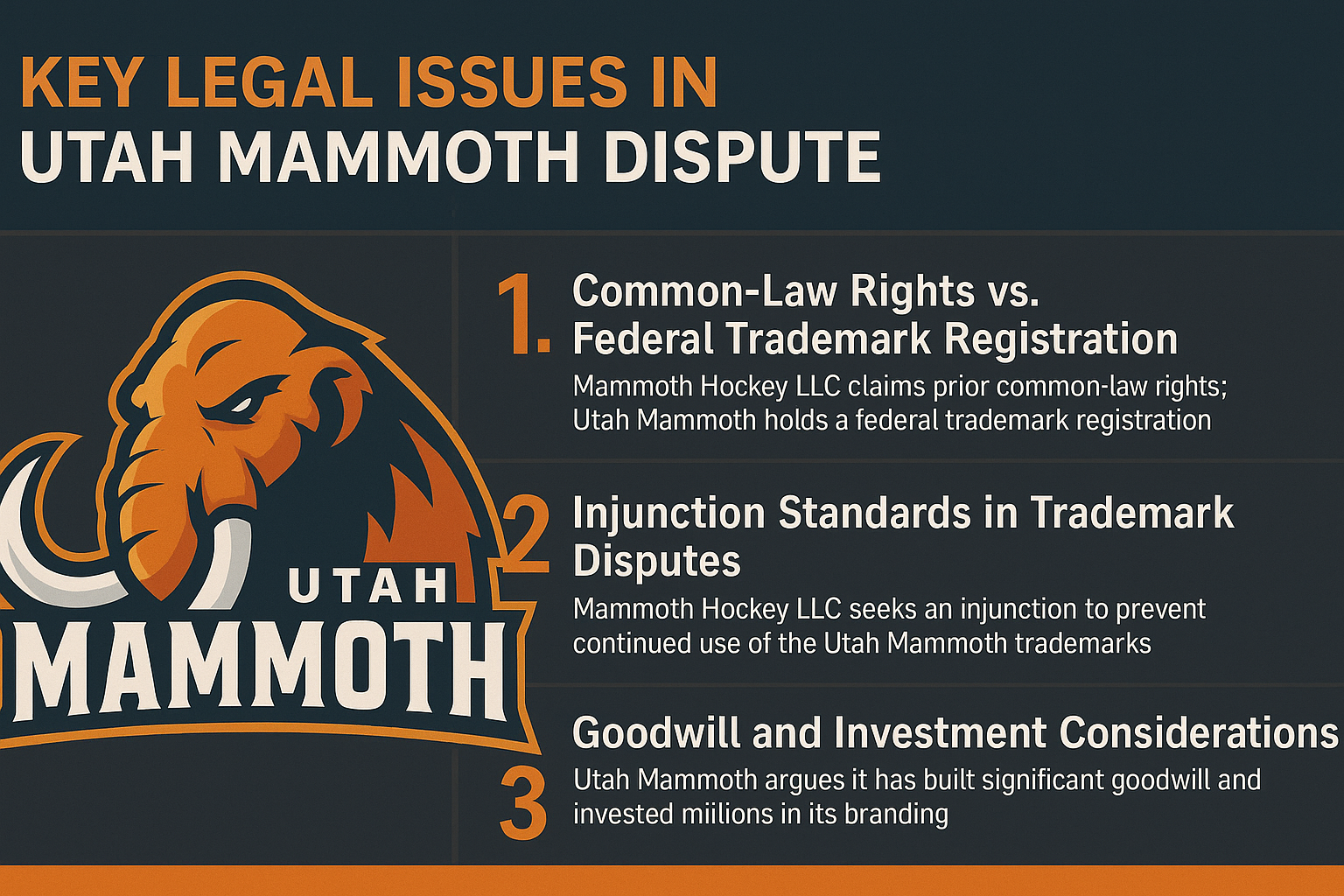
Key Legal Issues in the Utah Mammoth Case
1. Common-law rights vs. federal trademark registration
Mammoth Hockey LLC never secured a federal registration for “Mammoth” or any related mark. Their claims rely entirely on common-law rights — a far weaker position.
2. Injunction standards in trademark disputes
For the plaintiff to stop the NHL team’s brand use, they must prove likelihood of confusion and sufficient market presence to justify blocking a multi-million-dollar operation.
3. Goodwill and investment considerations
Courts often weigh the financial harm to the defendant. Rebranding a major franchise can cost tens of millions, tipping the balance against smaller challengers with limited market footprint.
4. Cross-industry confusion analysis
Selling hockey bags vs. operating an NHL franchise — while related in theme — may be considered separate enough to minimize confusion for most consumers.
5. Timing and motive
Prior friendly communications between the parties raise questions about why the lawsuit emerged only after the team’s high-visibility launch.
Trademark Strategy Insights
The case highlights several critical lessons:
- Companies relying solely on common-law rights face steep uphill battles.
- Federal trademark registration provides presumptions of ownership, nationwide priority, and significantly stronger enforcement power.
- Major brands reviewing new names routinely search the USPTO database; without a filing, conflicts go unnoticed until too late.
- Early-IP strategy is a low-cost, high-impact business decision, especially before investing millions into branding.
' width='400' height='200'/%3E%3C/svg%3E)


Let’s look at the trademark dispute between the Utah Mammoth — the new NHL franchise — and a bag company operating as Mammoth Hockey LLC.
Mammoth Hockey claimed it had prior rights to the name “Mammoth” and tried to pressure the NHL team, presumably hoping for a payout. But Utah Mammoth didn’t back down. At first, I thought this might be another example of a big organization failing to check whether the name they wanted was already trademarked — something that can lead to massive, expensive consequences.
But after digging into the records, it turns out that Mammoth Hockey LLC never had a federal trademark registration for MAMMOTH, MAMMOTH HOCKEY, or anything close. Nothing on file. And if that’s true, the strongest claim they have is based on common-law trademark rights.
And this brings us back to a point I’ve been repeating for years: relying solely on common-law rights is one of the riskiest decisions a brand owner can make. Common-law rights only exist when recognized by a court, and you have to prove every element — that your business used the mark first, that consumers in a specific geographic area associate the brand with you, and that your reputation is strong enough to justify blocking someone else. That’s a tall order. A website and some sales aren’t enough.
In this case, if the NHL franchise can demonstrate that blocking their use of “Utah Mammoth” would result in substantial, multi-million-dollar losses, a court could easily conclude that Mammoth Hockey’s earlier use was minimal and that its common-law rights don’t outweigh the team’s interests. That’s the reality of litigating without a registration.
Now imagine the alternative: if Mammoth Hockey had filed a federal trademark application early on. It would have cost them comparatively little, and two things would likely have happened:
1. The NHL’s attorneys would have found the registration immediately. They probably would have avoided the name altogether or approached Mammoth Hockey to license or purchase the rights.
2. If they still moved forward, Mammoth Hockey would have had a powerful legal position. A federal registration carries presumptions of ownership, validity, and nationwide notice. In that scenario, they could have mounted a much stronger case — potentially enough to force the NHL to rebrand, regardless of how much money was at stake.
That’s the difference a simple trademark filing makes.
So regardless of how this case ends — whether the NHL wins or Mammoth Hockey manages to salvage something — the lesson is the same: if you value your brand, register it. Otherwise, enforcing your rights becomes dramatically more expensive, unpredictable, and uncertain.