

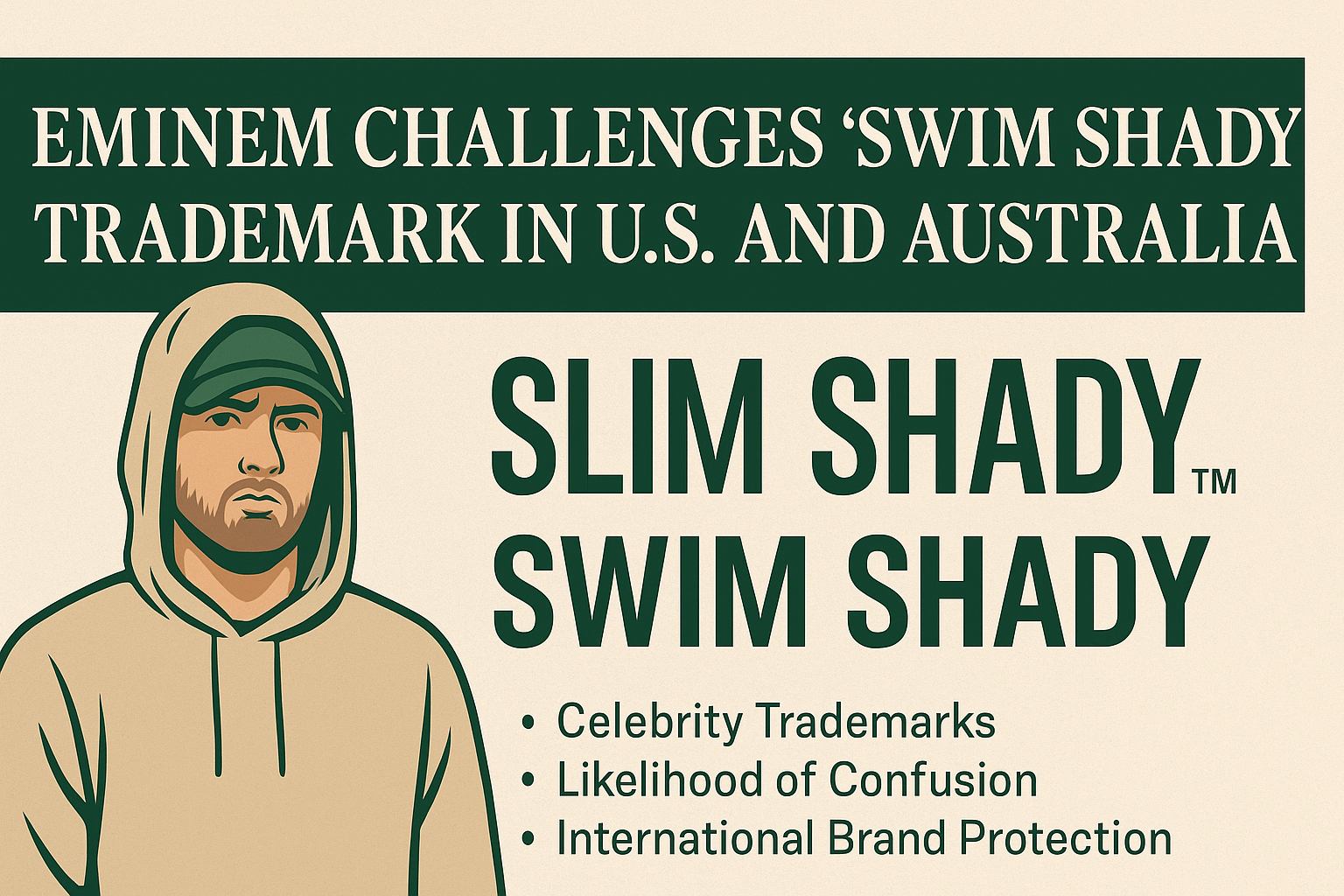
This week, Eminem (Marshall B. Mathers III) launched legal actions in both the United States and Australia against an Australian beachwear startup operating under the name Swim Shady — a brand he argues is confusingly similar to his world-famous alter ego Slim Shady. The dispute highlights the risks associated with brand mimicry, the power of long-standing trademark rights, and the increasing challenges celebrities and companies face in protecting their names in global markets.
What Happened: Eminem vs. Swim Shady
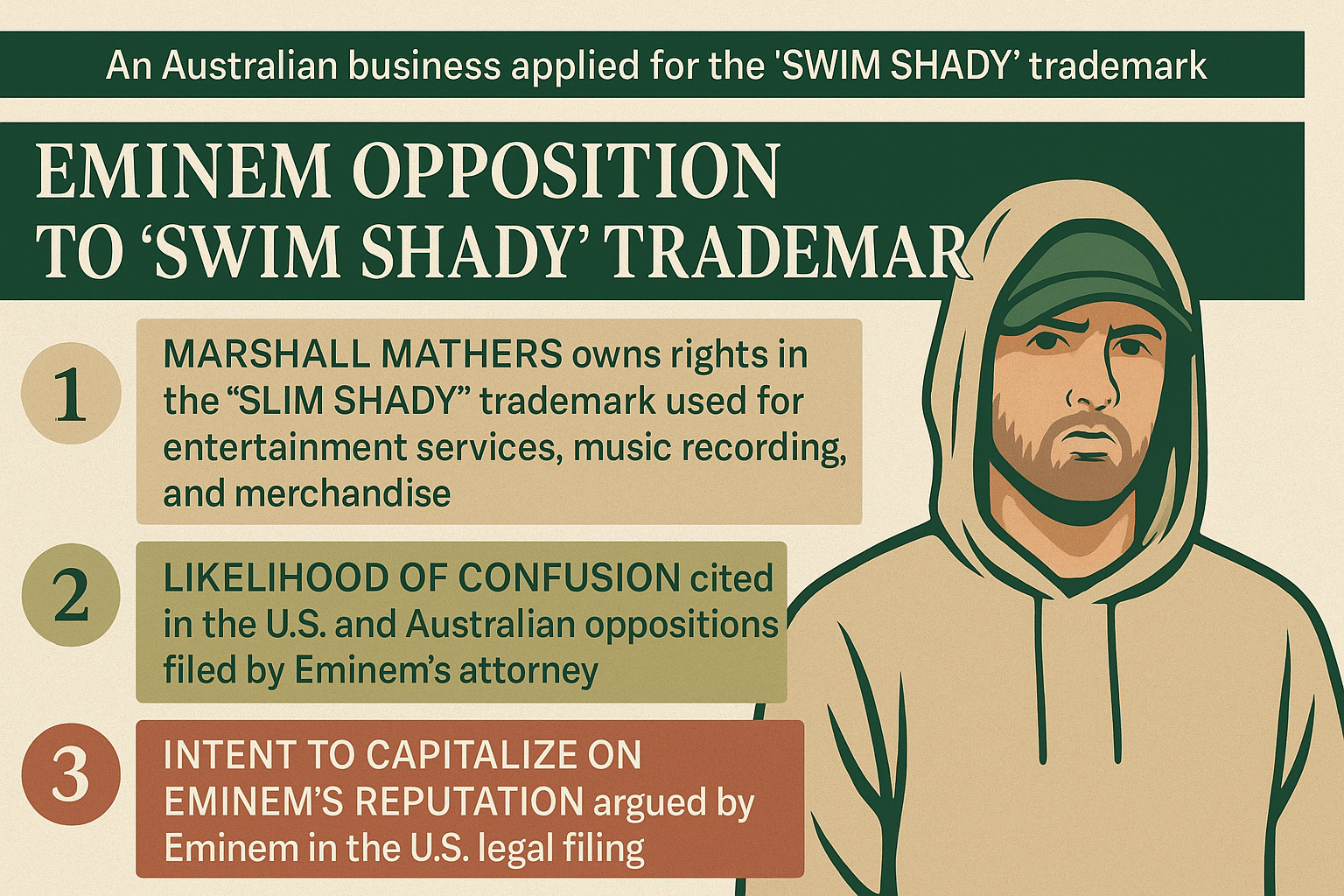
According to the BBC and USPTO filings, Eminem filed a petition to cancel the U.S. registration for SWIM SHADY, arguing that the name:
- creates a false association,
- capitalizes on decades of goodwill behind Slim Shady, and
- infringes on a mark that has been famous since the late 1990s.
The Australian company originally operated under the name Slim Shade, later rebranding to Swim Shady — a move that strengthens Eminem’s likelihood-of-confusion argument.
The beachwear brand officially launched in 2024 and offers:
- portable beach umbrellas
- swim bags
- beach accessories
The company secured a U.S. trademark earlier the same year — before Eminem filed his cancellation petition.
Eminem also initiated proceedings in Australia, where courts and IP offices have a reputation for strict treatment of foreign trademarks.
The case echoes another high-profile Australian dispute involving Katy Perry vs. Katie Perry, underscoring how even famous individuals can struggle to enforce names across jurisdictions.
Why This Case Matters: Trademark Confusion & International Risk
The central issue is likelihood of confusion — whether consumers may believe Swim Shady is connected to Eminem’s Slim Shady brand. Factors strengthening Eminem’s case include:
- identical structure and rhythm of the names
- synonymous sound and identical cadence
- fame of Eminem’s trademark
- the startup’s prior name “Slim Shade”
- cross-industry merchandising overlap (Class 25 clothing)
But the case also reveals something deeper:
👉 Even famous trademarks are vulnerable if owners fail to monitor new filings promptly.
Swim Shady’s U.S. registration went through unchallenged because Eminem’s legal team missed the application window — forcing them into a more difficult cancellation process.
Official Trademark Records
Slim Shady (Eminem) trademark — Class 25:
Swim Shady trademark (granted)
Legal and Brand Strategy Lessons
1. Fame doesn’t guarantee protection.
Even globally recognized trademarks can be undermined by missed deadlines.
2. Monitoring trademark filings is essential.
Watching services exist for a reason — they prevent exactly this scenario.
3. Opposition is easier than cancellation.
Catching a conflicting mark before registration dramatically increases chances of success.
4. International markets create additional layers of risk.
Australia is known for strict enforcement and prior-user complexities (see: Hungry Jack’s vs. Burger King).
5. Opportunistic registrations are becoming more common.
As brands globalize, entrepreneurs increasingly register names that resemble famous marks.
' width='400' height='200'/%3E%3C/svg%3E)

Eminem has owned SLIM SHADY trademarks in the U.S. for more than two decades. He filed his first application back in 2000, with registration issuing in 2002, and he holds multiple marks across various classes. The most relevant here is the mark in Class 25 (clothing), registered in September 2002.
But here’s where things get messy: in September 2024, an Australian company filed its own SWIM SHADY trademark application. Eminem’s legal team didn’t catch it, and the application sailed through examination without objection and proceeded all the way to registration.
This case is a textbook reminder of why trademark owners must actively monitor new filings even after they secure their own registrations. Had Eminem’s team been watching, they would have spotted the application early and filed an opposition. Opposing a mark before registration is dramatically easier than canceling a mark afterward. Once a trademark is registered, the burden of proof flips — instead of the applicant needing to justify that it’s distinct from yours, you now have to convince authorities that the examiner got it wrong.
And that is a much heavier lift.
So Eminem’s options in the U.S. are now significantly narrower. A cancellation proceeding is still possible, but it’s more complex, slower, and far from guaranteed.
As for Australia… well, Australia has a long, colorful history of challenging foreign brands — just ask Burger King, which famously had to rebrand as Hungry Jack’s because the Australian mark was already taken. So while Eminem might eventually succeed in canceling the U.S. registration, his prospects in Australia are likely to be much tougher. That mark may be there to stay.
We’ll keep watching how this plays out.