
The global whiskey market is booming, with new craft distilleries launching every year and established brands expanding into international markets. In such a competitive environment, your brand identity becomes one of your most valuable assets. From the bottle shape and label design to the brand name and logo, every element of your whiskey’s presentation affects brand recognition—and your legal rights.
Trademarking a whiskey brand is not just a formality. It is a strategic investment in protecting your long-term reputation, securing your market position, and preventing competitors from benefiting from your creativity and craftsmanship.
This guide outlines everything distilleries need to know about trademarking whiskey brands, from legal restrictions and bottle-shape protection to international expansion and common mistakes to avoid.
What Makes Whiskey Branding Legally Unique
Whiskey branding is governed by a combination of trademark law, industry regulations, and geographical protections. Unlike many other alcoholic beverages, whiskey often comes with strict identity requirements, unique regional rules, and a heavy reliance on packaging aesthetics.
Key Factors That Make Whiskey Legally Sensitive:
- Strong historical branding traditions — whiskey brands often feature heritage elements, seals, and vintage-inspired designs.
- Regulatory oversight — in the U.S., the TTB regulates label claims and packaging terminology.
- Geographical indications (GI) — terms like Scotch, Irish Whiskey, Bourbon are legally protected.
- High packaging significance — bottle shape, wax seals, label textures, and embossing often become signature identifiers.
Because whiskey has such a deep cultural and regional identity, trademark examiners scrutinize applications carefully.
What You Can Trademark for a Whiskey Brand
Trademark law allows distilleries to protect far more than just a name. Below are the most valuable assets that can—and should—be protected early.
Brand Name (Word Mark)
Your whiskey’s name is your most important brand asset. Securing it prevents others from using confusingly similar names.
Examples:
– Maker’s Mark®, Basil Hayden®, Woodford Reserve®
Logo and Graphic Identity
Whiskey branding often includes crests, emblems, or stylized lettering.
Label Design (Trade Dress)
Your label’s layout, colors, fonts, and stylistic choices can become protectable if they act as a brand identifier.
Bottle Shape (3D Trademark)
Iconic whiskey brands use distinctive bottles:
- Jack Daniel’s square bottle
- Maker’s Mark dipped wax top
- Wild Turkey bottle silhouette
Bottle shape trademarks require the design to be non-functional and unique.
Signature Packaging Elements
This may include:
- wax seals
- textured glass
- metal medallions
- embossed labels
- wooden corks
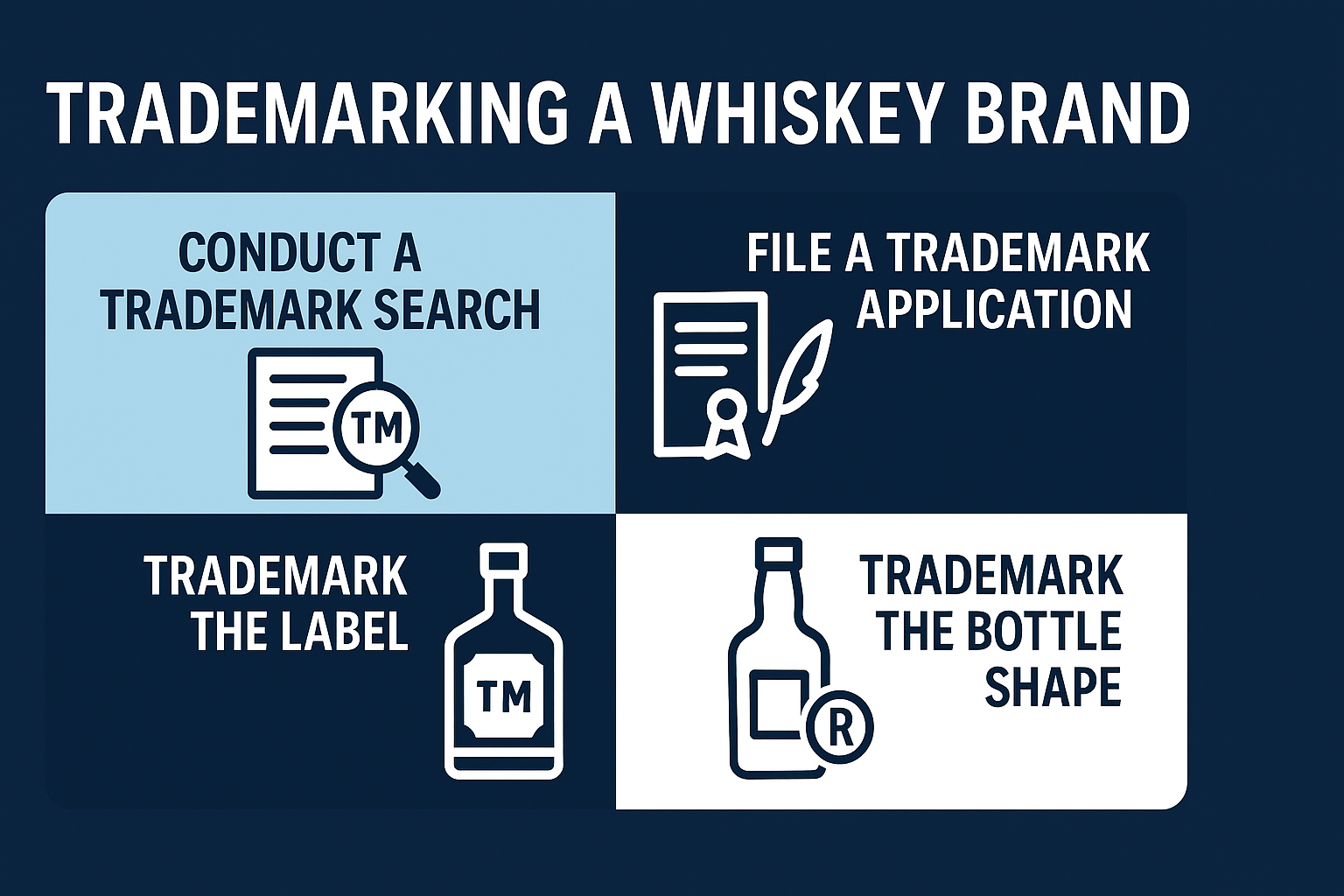
Table: Protectable vs. Unprotectable Whiskey Brand Elements
| Brand Element | Protectable? | Notes |
|---|---|---|
| Brand name | ✔ Yes | Strongest protection |
| Logo | ✔ Yes | Standard trademark |
| Label layout | ✔ Yes | If distinctive and consistent |
| Bottle shape | ✔ Yes | Must be non-functional |
| Wax color | ✔ Yes | If used consistently |
| Aging statements | ✖ No | Regulated and descriptive |
| Distillation terms | ✖ No | Generic industry language |
| Geographic origins (Scotch, Bourbon) | ✖ No | GI protected |
Legal Limitations in Whiskey Trademarking
Because whiskey has strict regulatory origins, not all brand elements are registrable.
Geographical Indications (GI) Restrictions
The following terms cannot be trademarked unless the whiskey meets specific GI rules:
- Scotch Whisky
- Irish Whiskey
- Canadian Whisky
- Bourbon
- Tennessee Whiskey
These names are legally restricted to authorized producers in specific regions.
Misleading or Descriptive Terms
Trademark offices will reject names that imply:
- origin (e.g., “Scottish Barrel Whiskey” for a U.S. brand)
- production method (“Charcoal Filtered”)
- aging characteristics (“20-Year Reserve”)
These are considered descriptive or deceptive.
Trademarking Process for Whiskey Brands
Protecting your whiskey brand involves several legal and technical steps.
Comprehensive Trademark Search
Because the whiskey industry is saturated, name conflicts are extremely common. The search must include:
- USPTO TESS
- WIPO Global Brand Database
- EUIPO
- Alcohol industry directories
- Marketplaces and distributors
- International brand registries
A thorough search helps avoid oppositions, lawsuits, and expensive rebranding.
Preparing the Trademark Application
You must specify:
- Class 33 (whiskey, spirits, alcoholic beverages)
- Label images (for design or trade dress marks)
- Bottle shape photographs (for 3D marks)
- Ownership entity (distillery, holding company)
Submitting the Application
Trademark offices require:
- clear descriptions
- accurate classification
- high-quality drawings/images
Responding to Office Actions
Common objections:
- similarity to existing whiskey brands
- geographic descriptiveness
- misleading references
- decorative elements mistaken for non-trademark use
Protecting Packaging & Trade Dress
Whiskey packaging is often a key brand differentiator. Trade dress protection can cover:
- embossed glass patterns
- wax-dipped tops (Maker’s Mark precedent)
- label shape and layout
- bottle silhouette
- cap style or closure design
Trade dress must be distinctive and used consistently across product lines.
International Strategy for Whiskey Trademarks
Whiskey brands frequently expand globally, especially in:
- United States
- European Union
- United Kingdom
- Japan
- China
- South Korea
- Australia
Why China Requires Immediate Registration
China operates on a “first-to-file” system.
Failure to register early can allow third parties to hijack your brand.
Trademark Factory® strongly recommends filing in export markets before distribution begins.
Common Mistakes Distilleries Make
Many whiskey brands unintentionally weaken their trademark protection. Mistakes include:
- choosing descriptive or trendy names (“Barrel Aged,” “Smoked Oak”)
- relying solely on copyright instead of trademarking labels
- not protecting bottle shape early
- rebranding without clearing the new name
- assuming international rights are automatic
- waiting too long to file a trademark
How Trademark Factory® Helps Distilleries Build Strong Whiskey Brands
Trademark Factory® provides:
- full clearance search
- fixed-fee trademark registration
- preparation of label and bottle filings
- international filing strategy
- handling office actions
- guaranteed results
👉 Book Your Free Whiskey Brand Strategy Call
👉 Explore How Trademark Factory® Protects Alcohol Brands
FAQ — Whiskey Brand Trademarks
Can I trademark my whiskey bottle shape?
Yes—if it is distinctive and non-functional.
Can wax color be trademarked?
Yes, if consistently used as a brand identifier.
Can two whiskey brands use similar names?
Only if no likelihood of consumer confusion exists—and this is rare.
Do I need to trademark the brand name and logo separately?
Yes. Separate filings increase your protection.
Does trademarking protect aging statements (e.g., 12-year)?
No. Aging statements are descriptive.
Should I register internationally?
Absolutely, especially if exporting to Asia, EU, or the UK.
Useful Resources
- USPTO Trademark Search
- WIPO Madrid System
- EUIPO Trademark Registry
- TTB Labeling Rules
- Trademark Factory® Blog
Conclusion
Trademarking a whiskey brand is a critical step for any distillery, from heritage producers to modern craft startups. By protecting your name, label design, and bottle shape, you safeguard your identity, build consumer trust, and ensure that your whiskey stands apart in a crowded market. With the right trademark strategy—and expert guidance from Trademark Factory®—your brand can expand confidently across domestic and global markets.
' width='400' height='200'/%3E%3C/svg%3E)