
If there’s one trademark class where people rush the most, it’s Class 25.
Why?
Because clothing brands move fast.
You launch the website.
You print the hoodies.
You build hype on Instagram.
Orders start coming in.
And then someone says:
“You should trademark that before someone steals it.”
So you open the USPTO website and think:
“It’s just clothing. How hard can this be?”
And that’s where most mistakes begin.
Not because clothing trademarks are complicated.
But because people underestimate how precise the system is.
Let’s talk about the mistakes that actually cause problems — not theoretical ones.
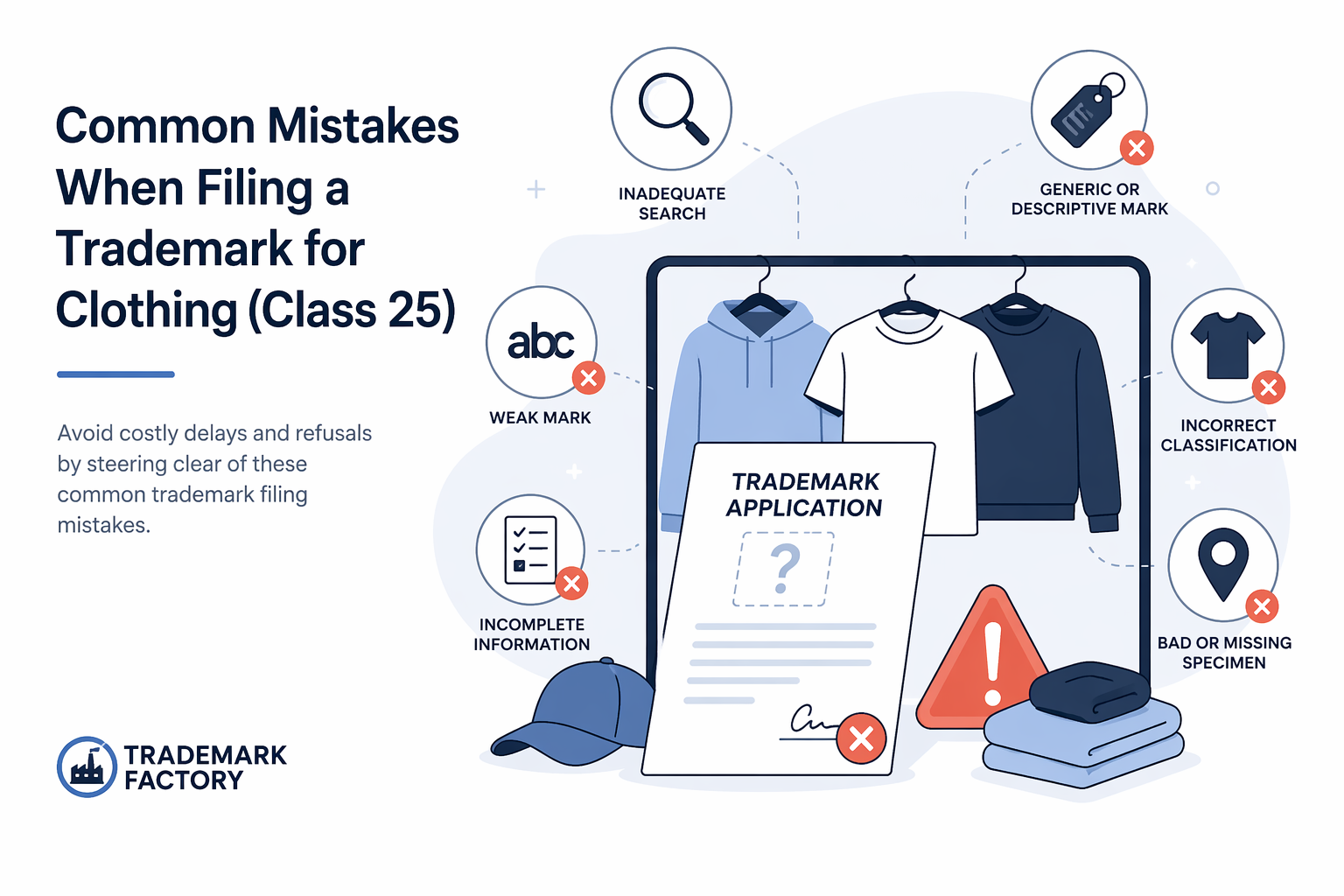
Mistake #1: Filing Without a Real Trademark Search
This is the most expensive mistake.
Class 25 is one of the most crowded trademark classes in the United States.
Think about it:
- Thousands of streetwear brands
- Fitness brands
- Shopify startups
- Amazon private labels
- Influencer merch brands
Everyone is filing in Class 25.
And many names sound similar.
Here’s what happens all the time:
Someone launches a clothing brand called:
“URBAN WAVE”
They search Google.
Nothing obvious shows up.
They file.
Six months later, the USPTO issues a refusal because of an earlier mark:
“URBAN WAVES”
In Class 25.
That filing fee? Non-refundable.
The branding work? Already done.
The website? Live.
Now they either:
- fight it (costly), or
- rebrand (painful), or
- abandon the application (wasted time + money)
This is why a proper trademark search matters — especially in Class 25.
If you want to start correctly
Mistake #2: Filing Only “Clothing” — and Nothing Else
This one feels harmless.
People file:
“Clothing” — Class 25.
But in reality, they sell:
- clothing
- hats
- socks
- maybe footwear
Yes, hats and shoes are still Class 25 — but if your wording is too narrow, you can create future limitations.
Even worse is when brands sell:
- clothing
- tote bags
- jewelry
- phone cases
…and only file Class 25.
They assume:
“It’s all fashion.”
But trademark classes don’t care about “fashion.”
They care about:
- goods categories
- Nice Classification
- specific descriptions
So your clothing might be protected — but your bags aren’t.
And if your brand grows around those bags later, you may discover the gap too late.
Mistake #3: Ignoring Class 35 (When It Actually Matters)
We just talked about Class 25 vs 35 in the previous article — and this is where the confusion turns into a mistake.
Many clothing brands operate as full online retail brands.
They’re not just printing a logo on shirts.
They’re running:
- branded Shopify storefronts
- curated drops
- retail experiences
- collaborations
Sometimes, Class 35 (retail services) becomes strategically important.
But many founders ignore it because:
“I just sell clothing.”
And sometimes that’s true.
But sometimes it’s not.
The mistake isn’t skipping Class 35.
The mistake is not evaluating whether it applies to your business model.
Mistake #4: Submitting a Weak or Incorrect Specimen
This one surprises people.
When you file based on “use in commerce,” the USPTO requires proof.
For clothing, that usually means:
- a label sewn into the garment
- a hang tag
- packaging
- or a website product page that clearly shows the mark used in connection with the goods
But here’s what often gets rejected:
- a mockup
- a photoshopped logo on a hoodie
- a social media graphic
- a brand mood board
The USPTO wants real commercial use — not a design preview.
We’ve seen clothing brands delay their applications by months because of specimen issues.
Mistake #5: Filing Too Early (Before Real Use Exists)
Some founders try to file “use in commerce” before they’ve actually sold anything.
They upload:
- a website that isn’t live
- a product page with no way to buy
- a pre-launch page
And the USPTO rejects the specimen.
If you’re not yet selling, you may need to file under “intent to use” instead — and that has a different timeline and requirements.
Filing too early in the wrong basis can create unnecessary complications.
Mistake #6: Thinking a Trademark Protects Everything Automatically
This is more psychological than legal — but it causes real damage.
Some brand owners believe:
“Once I get a trademark, no one can use my name anywhere.”
But trademarks are tied to:
- specific goods
- specific classes
- specific commercial use
If you file only for clothing in Class 25, and someone else uses the same name for perfume (Class 3), that’s a different legal analysis.
The scope of protection depends heavily on how you file.
Mistake #7: Copying Someone Else’s Trademark Description
We see this more than you’d expect.
Someone looks up another brand’s registration and copies their goods wording.
But that other brand might:
- operate differently
- sell different products
- have different specimen evidence
What worked for them may not match your real business.
And if your wording doesn’t match your real use, you create risk.
The USPTO ID Manual exists for a reason:
| Mistake | What Happens |
|---|---|
| No trademark search | Likelihood of confusion refusal |
| Filing only Class 25 when more classes needed | Gaps in protection |
| Weak specimen | Office Action |
| Filing too early | Specimen rejection |
| Overly broad wording | Amendment requests or refusal |
| Ignoring business model | Strategic mistakes |
Why Class 25 Is Especially Risky
Class 25 is crowded.
That means:
- More similar names exist
- More likelihood of confusion refusals
- More aggressive competitors
- More overlap in branding
A clothing brand name that sounds “unique” creatively may still be legally similar to another registered mark.
For example:
- VYBEWEAR
- VIBE WEAR
- VYB WARE
Creatively different.
Legally? Possibly confusingly similar.
A Realistic Filing Strategy for Clothing Brands
If you want to reduce risk dramatically:
- Run a proper trademark search.
- Confirm which classes truly apply.
- Choose precise goods wording.
- Make sure your specimen is real and compliant.
- File with a strategy — not just urgency.
Helpful Resources
Related TrademarkFactory Services
- Trademark Search & Assessment
- Trademark Filing & Registration
- Office Action Response
- Statement of Use Filings
- Trademark Monitoring
FAQ: Common Class 25 Filing Questions
Is Class 25 hard to get approved?
It’s not harder legally — but it’s more competitive because so many brands file in it.
What’s the biggest reason clothing trademarks get refused?
Likelihood of confusion with an earlier mark in Class 25.
Can I fix a mistake after filing?
Sometimes, but not always. And corrections can cost time and additional fees.
Is it safer to file multiple classes?
Only if they actually apply to your business model.
' width='400' height='200'/%3E%3C/svg%3E)