

If you’re building a clothing brand and you’ve started looking into trademarks, there’s a moment almost everyone hits.
You’re feeling confident at first — because you’ve figured out the basics:
“I sell clothing. Clothing is Class 25. Great. Done.”
And then you read a forum thread, or a Reddit comment, or a blog post, or someone in a Facebook group says:
“Don’t forget Class 35.”
And suddenly you’re confused again.
Because now you’re thinking:
- Wait, why would I need a different class if I sell clothes?
- Isn’t a Shopify store just… a store?
- Does the USPTO treat online selling differently?
- Am I going to mess this up and have to pay twice?
This article is here to answer that question in a way that makes sense in the real world — not just in trademark terms.
The problem: modern clothing brands are not “just clothing brands” anymore
Here’s the thing the USPTO system doesn’t really care about:
Most clothing brands today are built like media companies.
Even small brands are doing:
- Instagram content
- TikTok marketing
- “drops” and limited releases
- collaborations
- brand storytelling
- and a full online shopping experience
So from the outside, your brand looks like a business.
But the USPTO doesn’t categorize trademarks based on “brand energy.”
It categorizes them based on what you sell and what service you provide.
That’s why Class 25 and Class 35 get mixed up constantly.
Let’s talk about Class 25 like a normal person
Class 25 is the easy one.
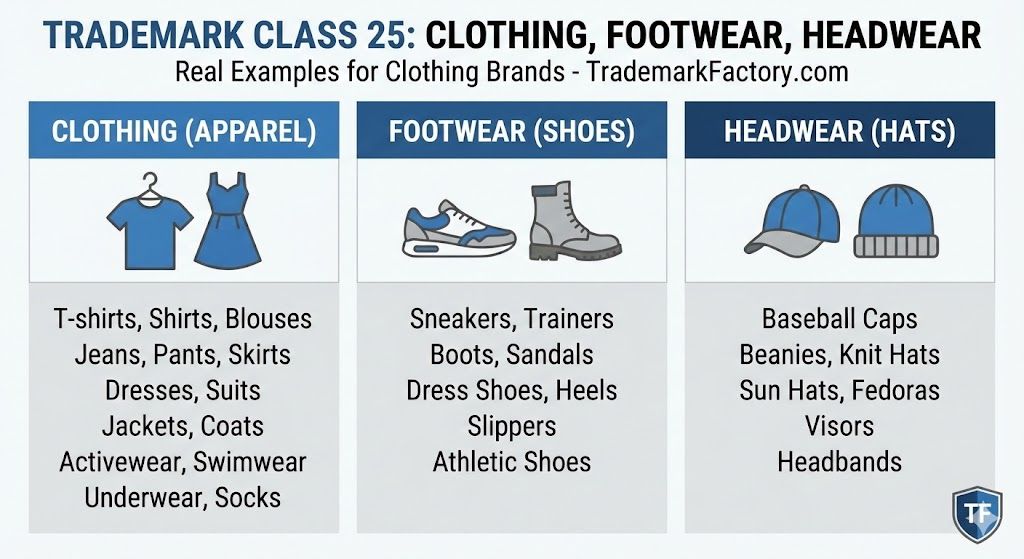
Class 25 is the trademark class for:
- clothing
- shoes
- hats
Basically, the stuff that people wear.
If you sell hoodies, leggings, t-shirts, sneakers, or caps — you are in Class 25.
And when your trademark is printed on:
- a neck label
- a hang tag
- a shoe box
- or even shown properly on a product page
…Class 25 is the class that protects that use.
So far, no confusion.
So what is Class 35 — and why does it even exist?
Class 35 is where things start to feel weird.
Because Class 35 isn’t about products.
It’s about services.
And one of the biggest services in Class 35 is:
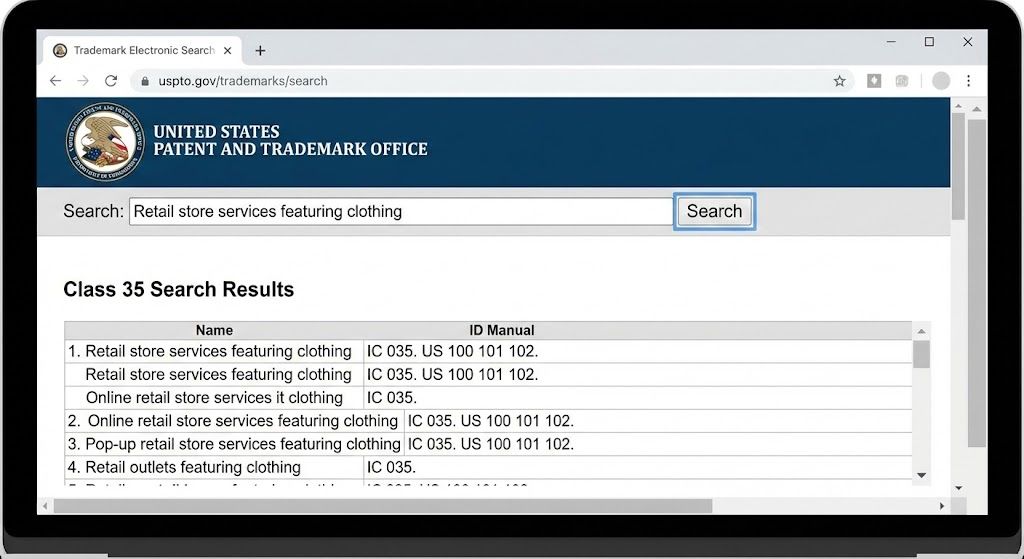
Retail store services (including online retail store services)
That’s the key phrase.
Class 35 is basically the class that covers:
- “I run a store that sells products.”
And yes, that includes online stores.
So when people say “you might need Class 35,” what they’re really saying is:
“You might not only be a clothing brand.
You might also be a retail brand.”
Here’s the simplest explanation (and it’s the one that actually helps)
Think of it like this:
Class 25 protects your trademark as a label on the clothing.
Class 35 protects your trademark as the name of the store selling the clothing.
That’s it.
And this is why it’s confusing:
Because most brands do both.
You’re not just printing a logo on a hoodie.
You’re also selling that hoodie through a branded store experience.
A real example (because this makes it click for most people)
Let’s imagine a brand called NORTHWAVE.
They sell:
- hoodies
- t-shirts
- sweatpants
They print NORTHWAVE on the clothing labels.
That’s Class 25.
Now, NORTHWAVE also has a Shopify store: northwave.com
And their homepage says:
“Welcome to NORTHWAVE. Shop the latest drop.”
They’re not just selling a hoodie.
They’re providing an online retail experience.
This is where Class 35 can become relevant.
But do you need both? Not always.
Here’s the part most blog posts skip:
Just because Class 35 exists doesn’t mean every clothing brand must file it.
Some brands can file only Class 25 and still be perfectly protected for their core business.
So what determines it?
Not “do you sell online.”
Because almost everyone sells online now.
The real question is:
Is your trademark being used as a retail service brand, or mainly as a product brand?
Why this matters: the USPTO is strict about what you claim
This is important, and it’s not just theory.
When you file a trademark, you’re not filing for “a brand.”
You’re filing for:
- specific goods
- and/or specific services
So when you choose Class 35, you’re telling the USPTO:
“My trademark is used for retail store services.”
If that’s true — great.
But if you claim retail services and you can’t support it properly later (with correct wording and evidence), you can create problems.
The Shopify confusion (and why people panic)
Let’s address the most common scenario:
You run a Shopify store selling only your own branded clothing.
You are not a marketplace.
You are not a boutique.
You are not selling other brands.
You are selling your own products.
So you might think:
“But I still have a store. Doesn’t that mean Class 35?”
Not necessarily.
Because the USPTO doesn’t treat every website as a “retail service.”
A website can simply be:
- a place where you sell your own goods
- under your own brand
- without offering retail services for others
In that case, Class 25 is often the core class.
When Class 35 becomes more clearly relevant
Class 35 becomes much more relevant when your business model looks like one of these:
1) You run a boutique or curated store
Meaning you sell:
- multiple brands
- multiple product lines
- curated selections
- not just your own goods
2) You operate like a marketplace
For example:
- multiple sellers
- multiple brands
- a platform model
3) Your brand is positioned as “the store” first
This happens a lot with:
- streetwear resell platforms
- luxury consignment
- fashion marketplaces
- curated online boutiques
A second real-world example (the boutique scenario)
Let’s say your brand is called THREADROOM.
THREADROOM sells:
- their own clothing line
- plus other designers
- plus accessories
- plus seasonal collections
Now THREADROOM is not only a product brand.
It’s a retail store service.
If someone else started a store called THREADROOM selling clothing, your Class 25 filing might not cover that retail service use.
That’s why Class 35 exists.
The money part (because yes, this is about money)
USPTO filing fees are charged per class.
So:
And USPTO fees are generally non-refundable.
So if you file an extra class “just in case,” you’re paying extra.
And if you skip a class you needed, you might have to file again later.
This is why class strategy matters.
It’s not a minor detail — it’s literally part of the cost.
This is the only table we really need here:
| If your business is… | Class 25 | Class 35 |
|---|---|---|
| A clothing brand selling its own apparel | Yes | Maybe |
| A boutique selling multiple brands | Yes (if you have your own products) | Yes |
| An online store brand / retail concept | Yes | Often yes |
| A marketplace platform | Not always | Yes |
So what do most clothing brands do?
Here’s what happens in real life:
Many small brands start with Class 25 only.
Because it protects the product use, which is the core of the business.
As the brand grows, Class 35 becomes more relevant.
Especially if the business expands into:
- retail services
- curated offerings
- collaborations and broader commerce
This is why trademark strategy isn’t “one size fits all.”
What about Amazon sellers?
Amazon sellers often ask:
“If I sell clothing on Amazon, do I need Class 35?”
Usually, Amazon private label sellers are primarily product brands.
So Class 25 is usually the first priority.
But Amazon sellers often expand into:
- multiple product categories
- branded accessories
- storefront brand identity
So sometimes Class 35 becomes useful later — but it depends.
What happens if you file only Class 25 and later regret it?
The good news: you can file again later.
The bad news: you can’t usually “upgrade” your old filing for free.
It’s a separate filing, separate fee, separate timeline.
So the best approach is:
Don’t guess. Decide strategically.
How to decide (without overthinking)
If you want a simple, practical decision rule:
If your brand is mainly the name on the clothing → Class 25 is the priority.
If your brand is also the identity of a store that sells products → Class 35 might matter.
And if you’re still unsure, the smartest move is to do a trademark search and strategy review first — because Class 25 is crowded, and filing incorrectly can cost you twice.
Helpful Resources (Official Links)
Related TrademarkFactory Services (Internal Links)
- Trademark Search & Assessment
- Trademark Filing & Registration
- Office Action Response
- Trademark Monitoring
FAQ: Trademark Class 25 vs 35
Do I need Class 35 if I sell clothing online?
Not automatically. It depends on whether your trademark is used primarily for goods (clothing) or also for retail store services.
Can I file only Class 25 and add Class 35 later?
You can file a separate application later, but you typically can’t just add it to the original filing.
Is Class 35 only for marketplaces?
No. It covers retail services more broadly, including online stores and boutiques.
Why do some clothing brands file both?
Because many brands grow beyond clothing into broader retail and commerce, and they want protection for both goods and services.
Final takeaway (real talk)
If you’re building a clothing brand, Class 25 is almost always the foundation.
Class 35 is the “it depends” class.
And the reason it depends is simple:
The USPTO separates products from services —
even if your business blends them together.
If you want to file confidently (and not pay twice), start with a search and a class strategy review.
' width='400' height='200'/%3E%3C/svg%3E)