

If you run a fashion brand, there’s a moment that almost always happens sooner or later.
You start with clothing.
It’s simple.
You sell t-shirts, hoodies, sweatpants — classic Class 25.
Then your customers start asking for accessories.
So you add:
- tote bags
- backpacks
- wallets
- maybe even a premium leather bag
And suddenly you’re in a different world.
Because now you’re thinking:
“Bags are part of fashion.
So they must be Class 25 too… right?”
And that’s where the mistake happens.
Why This Confusion Is So Common (And Totally Understandable)
From a branding perspective, clothing and bags feel like one category.
You sell them in the same store.
You shoot them in the same photos.
They’re styled together.
They’re part of the same lifestyle.
But trademark classes don’t follow fashion logic.
They follow the Nice Classification system — which separates goods by category.
So even though bags are sold by fashion brands, they are not considered clothing.
The Simple Answer
Here’s the core rule:
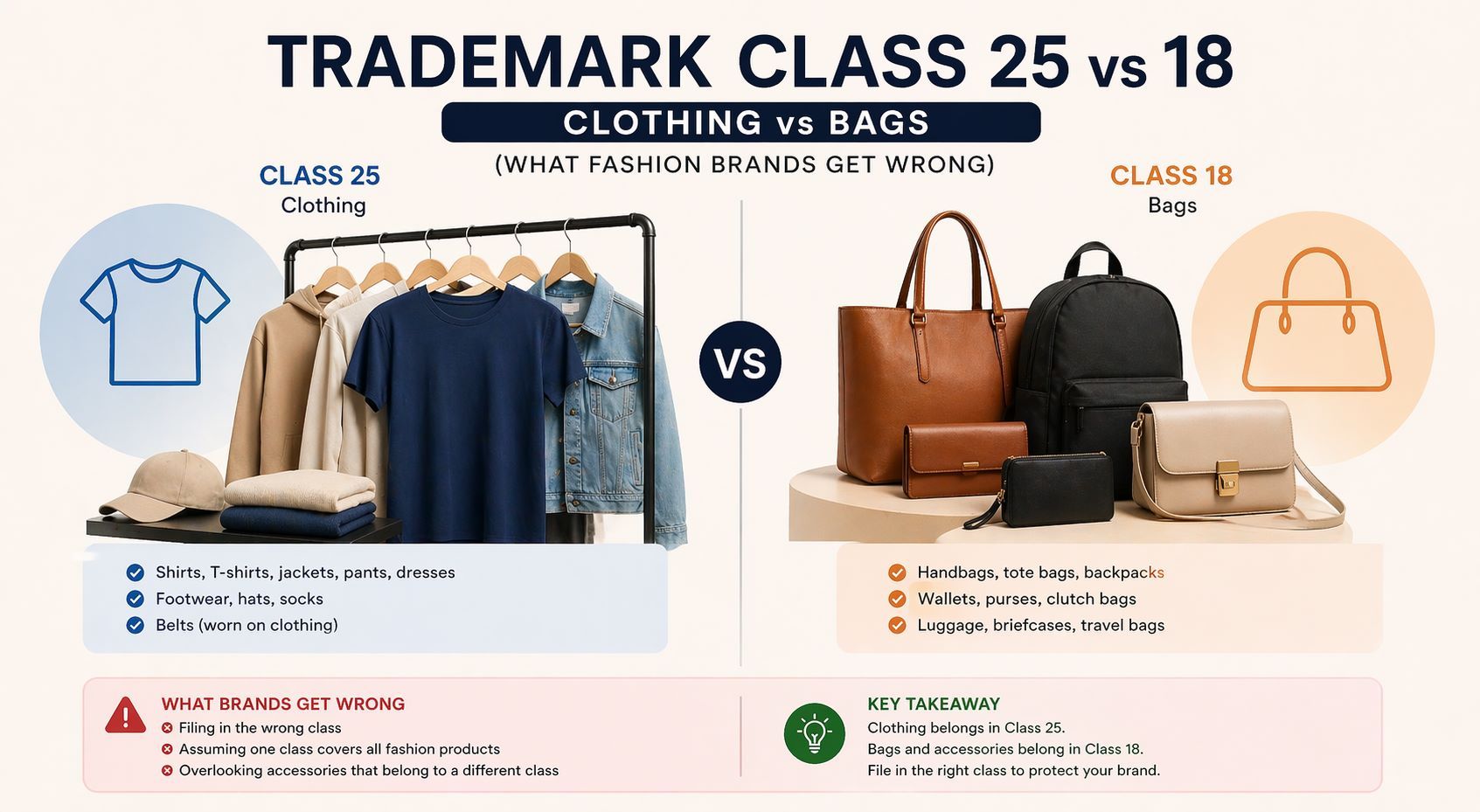
Class 25 = things people wear
Class 18 = things people carry
That’s the cleanest way to remember it.
What Class 25 Covers (Quickly)
Class 25 is:
- clothing
- footwear
- headwear
So if it’s something you put on your body to wear, Class 25 is the starting point.
What Class 18 Covers (And Why It Matters)
Class 18 is where many fashion brands expand without realizing they’ve entered a new legal category.
Class 18 commonly includes:
- handbags
- backpacks
- tote bags
- wallets
- purses
- duffel bags
- travel bags
- leather goods
In short:
If it’s a bag, it’s usually Class 18.
Even if it’s sold by a streetwear brand.
Even if it’s sold by a luxury fashion label.
Even if it’s your best-selling product.
Real Example: The Streetwear Tote Bag Problem
Let’s imagine a streetwear brand called NEON DISTRICT.
They sell:
- hoodies
- tees
- hats
They file in Class 25.
Everything seems fine.
Then they release a tote bag with the logo on it.
It sells out instantly.
Now the tote bag becomes part of their identity.
Here’s the issue:
If they only filed in Class 25, their trademark protection is focused on clothing.
The tote bag might not be properly protected under that filing.
So if another company starts selling bags under a similar name, enforcement may be harder.
This is why Class 18 matters for accessory-driven fashion brands.
The Biggest Mistake Fashion Brands Make
The biggest mistake isn’t “forgetting Class 18.”
It’s thinking:
“My trademark covers my brand, so it covers everything I sell.”
Trademark protection doesn’t work like that.
It covers your brand in connection with the goods and services you claimed.
So if you didn’t claim bags, you may have a gap.
| Product | Class |
|---|---|
| T-shirts, hoodies, sweatpants | 25 |
| Hats, caps, beanies | 25 |
| Sneakers, boots | 25 |
| Tote bags | 18 |
| Backpacks | 18 |
| Wallets | 18 |
| Leather handbags | 18 |
| Travel bags | 18 |
What About “Fanny Packs” and Crossbody Bags?
This is one of the most searched questions.
Because fanny packs are worn on the body.
So people assume Class 25.
But in trademark classification, most of these are still considered bags.
So they usually fall under Class 18.
The USPTO ID Manual is the safest place to confirm:
Why Class 18 Is So Important for Modern Brands
A decade ago, many clothing brands stayed mostly in apparel.
Today, accessory products are often:
- higher margin
- easier to ship
- more scalable
- better for branding
Tote bags, backpacks, and wallets often become:
- the most recognizable items
- the best-selling products
- the strongest “logo visibility” pieces
So if your brand is moving in that direction, Class 18 becomes strategically important.
When Should You File Both Class 25 and Class 18?
This is the question founders really want answered.
You should strongly consider filing both if:
- you already sell bags now
- you are launching bags within the next 6–12 months
- bags are a core part of your brand identity
- you’re building a lifestyle brand (not just apparel)
If bags are just a minor side item, you may start with Class 25 and expand later.
The Cost Factor (Because It Matters)
USPTO fees are per class.
So filing:
- only Class 25 = one fee
- Class 25 + 18 = two fees
Some brands avoid Class 18 because of budget.
That’s understandable.
But here’s the trade-off:
If bags become your main revenue stream later, filing Class 18 later may cost more in the long run.
This is why trademark strategy is part of business strategy.
What Happens If You File Only Class 25 and Later Add Bags?
You can file again later.
But you may lose the earlier priority date for bags.
And in crowded markets, that timing matters.
This is why some brands file early, even if the bag product line is still small.
Helpful Resources (Official Links)
Related TrademarkFactory Services (Internal Links)
- Trademark Search & Assessment
- Trademark Filing & Registration
- Trademark Monitoring
- Office Action Response
FAQ: Class 25 vs Class 18
Are tote bags Class 25?
No. Tote bags are usually Class 18.
Are backpacks Class 25?
No. Backpacks are usually Class 18.
Do I need Class 18 if I sell clothing and bags?
If bags are part of your product line, yes — Class 18 may be important for full protection.
What if my bag is fabric, not leather?
Material doesn’t always change the class. Many bags still fall under Class 18.
Can I file Class 18 later?
Yes, but it’s typically a separate application and fee.
Final Thought
If you’re building a fashion brand, the clothing is often just the beginning.
Bags and accessories can become the products that:
- scale the fastest
- carry the highest margins
- build the strongest brand recognition
And that’s exactly why Class 18 matters.
The simplest way to remember it:
Wear = Class 25
Carry = Class 18
' width='400' height='200'/%3E%3C/svg%3E)