

Receiving a Trademark Office Action can feel alarming — especially if you expected your trademark registration to move smoothly toward approval.
Instead, you receive a formal letter from the United States Patent and Trademark Office (USPTO) identifying problems with your application.
However, an Office Action does not mean your trademark has been rejected. In fact, many successful trademarks receive at least one during examination.
Understanding what it means — and how to respond — can determine whether your brand proceeds to registration or becomes abandoned.
What Is a Trademark Office Action?
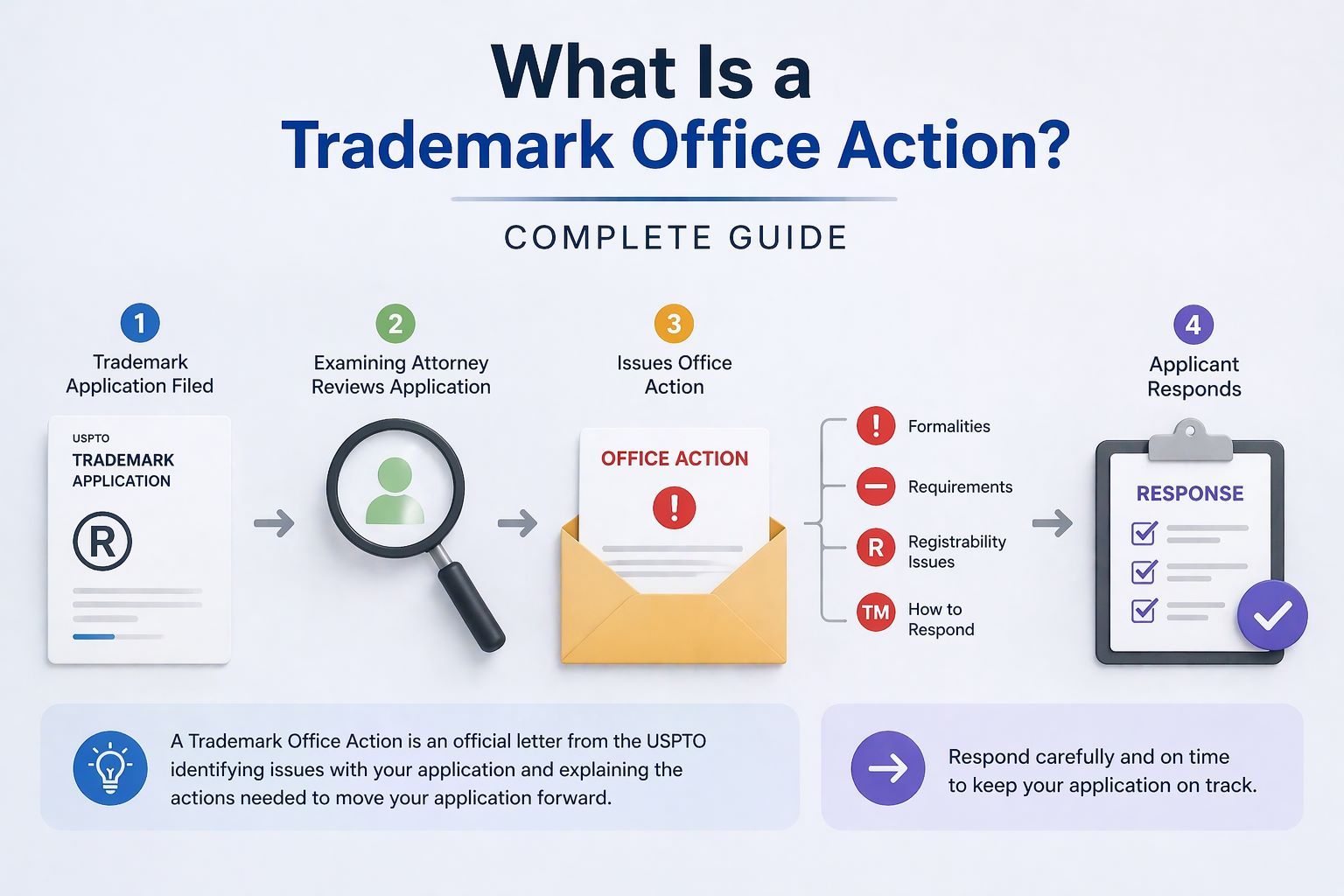
A Trademark Office Action is an official communication issued by a USPTO examining attorney reviewing a trademark application.
The letter explains legal or procedural issues that must be resolved before the trademark can proceed toward registration.
According to the USPTO:
➡ USPTO guidance on responding to Office Actions
The Office Action typically identifies:
- legal refusals
- missing application information
- evidence problems
- conflicts with existing trademarks
In practical terms, the Office Action means:
“Your application cannot be approved yet — these issues must be resolved first.”
Where Office Actions Appear in the Trademark Registration Process
Office Actions occur during the examination stage of the trademark registration process.
| Stage | What Happens |
|---|---|
| Trademark application filed | Application submitted to USPTO |
| USPTO examination | Attorney reviews legal compliance |
| Office Action issued | Issues or refusals identified |
| Applicant response | Applicant must resolve issues |
| Publication or refusal | Trademark proceeds or is rejected |
The USPTO reviews applications to ensure that each trademark:
- does not confuse consumers
- is distinctive
- correctly identifies goods or services.
➡ USPTO trademark examination process
The Two Types of Trademark Office Actions
There are two main types of Office Actions issued by the USPTO.
| Type | Meaning | Next Step |
|---|---|---|
| Non-Final Office Action | Initial issues identified | Applicant can respond |
| Final Office Action | Examiner maintains refusal | Appeal or reconsideration |
Most applicants first receive a non-final Office Action, which allows them to correct problems in the application.
Most Common Reasons for Trademark Office Actions
Understanding why Office Actions happen helps applicants prepare effective responses.
1. Likelihood of Confusion (Section 2(d))
The most common trademark refusal occurs when the USPTO determines that a new trademark is too similar to an existing registered trademark.
This is known as Likelihood of Confusion under Section 2(d) of the Lanham Act.
➡ USPTO likelihood of confusion explanation
Similarity may involve:
- appearance
- pronunciation
- meaning
- commercial impression
Example:
| Existing Trademark | New Application | Problem |
|---|---|---|
| CLOUDSYNC | CLOUDSINK | Similar pronunciation |
If consumers could reasonably believe the brands come from the same source, the application may be refused.
For a deeper analysis of this refusal, see:
➡ Likelihood of confusion explanation (TrademarkFactory article)
2. Descriptive Trademark Refusal
Another common issue occurs when a trademark simply describes the product or service.
Example:
| Mark | Product | Problem |
|---|---|---|
| FAST DELIVERY | Courier services | Describes service |
Descriptive marks are usually refused under Section 2(e)(1) of the Lanham Act.
➡ USPTO refusal grounds overview
However, descriptive marks may still register if the applicant proves acquired distinctiveness.
3. Specimen Refusal
For applications based on use in commerce, applicants must provide a specimen showing the trademark used in connection with the product or service.
Common specimen problems include:
- mock-up images
- packaging not used in real commerce
- website screenshots without purchase options
4. Identification of Goods and Services Problems
Another frequent issue is an unclear or overly broad description of goods or services.
Example:
❌ “Software”
✔ “Downloadable project management software”
The USPTO often requires applicants to revise descriptions using the official identification system.
➡ USPTO Identification of Goods and Services Manual
How Long Do You Have to Respond?
Office Action deadlines are strict.
Applicants generally have three months to respond.
➡ USPTO Office Action response deadlines
Applicants may request a three-month extension by paying a fee.
| Response Period | Duration |
|---|---|
| Initial deadline | 3 months |
| Extension | +3 months |
| Maximum response time | 6 months |
Failure to respond will result in application abandonment.
How to Respond to a Trademark Office Action
A response must address every issue raised by the examining attorney.
Common response strategies include:
Legal arguments
Explaining why the refusal does not apply.
Example:
- demonstrating differences between trademarks.
Application amendments
Updating goods and services descriptions or disclaiming descriptive terms.
Evidence submission
Providing supporting documentation such as:
- marketing materials
- industry evidence
- consumer recognition data.
Responses are typically filed electronically through the Trademark Electronic Application System (TEAS).
For a step-by-step explanation of responding to Office Actions, see:
➡ TrademarkFactory guide to Office Actions
Can a Trademark Still Be Approved After an Office Action?
Yes.
Many trademark applications proceed successfully after resolving Office Action issues.
| Outcome | Result |
|---|---|
| Issues resolved | Application proceeds |
| Refusal maintained | Final Office Action issued |
| Appeal filed | Case reviewed by TTAB |
Understanding the examiner’s reasoning and preparing a strategic response significantly increases the likelihood of approval.
FAQ: Trademark Office Actions
Does an Office Action mean my trademark is rejected?
No. An Office Action means the USPTO has identified issues with your application that must be resolved before approval.
How long do I have to respond to a trademark Office Action?
Most applicants have three months to respond, with an optional three-month extension available for an additional fee.
What happens if I ignore an Office Action?
If you do not respond by the deadline, the USPTO will abandon your trademark application.
Can I respond to an Office Action myself?
Yes. Applicants can submit responses through the USPTO TEAS system. However, complex refusals often require legal arguments and trademark expertise.
What is the most common reason for Office Actions?
The most frequent refusal is Likelihood of Confusion, when a new trademark is considered too similar to an existing one.
What is the difference between a non-final and final Office Action?
A non-final Office Action allows the applicant to fix issues. A final Office Action means the examiner maintains the refusal after reviewing the applicant’s response.
Can a trademark still be approved after a final Office Action?
Yes. Applicants may: request reconsideration, amend the application, appeal the decision to the Trademark Trial and Appeal Board (TTAB).
' width='400' height='200'/%3E%3C/svg%3E)