

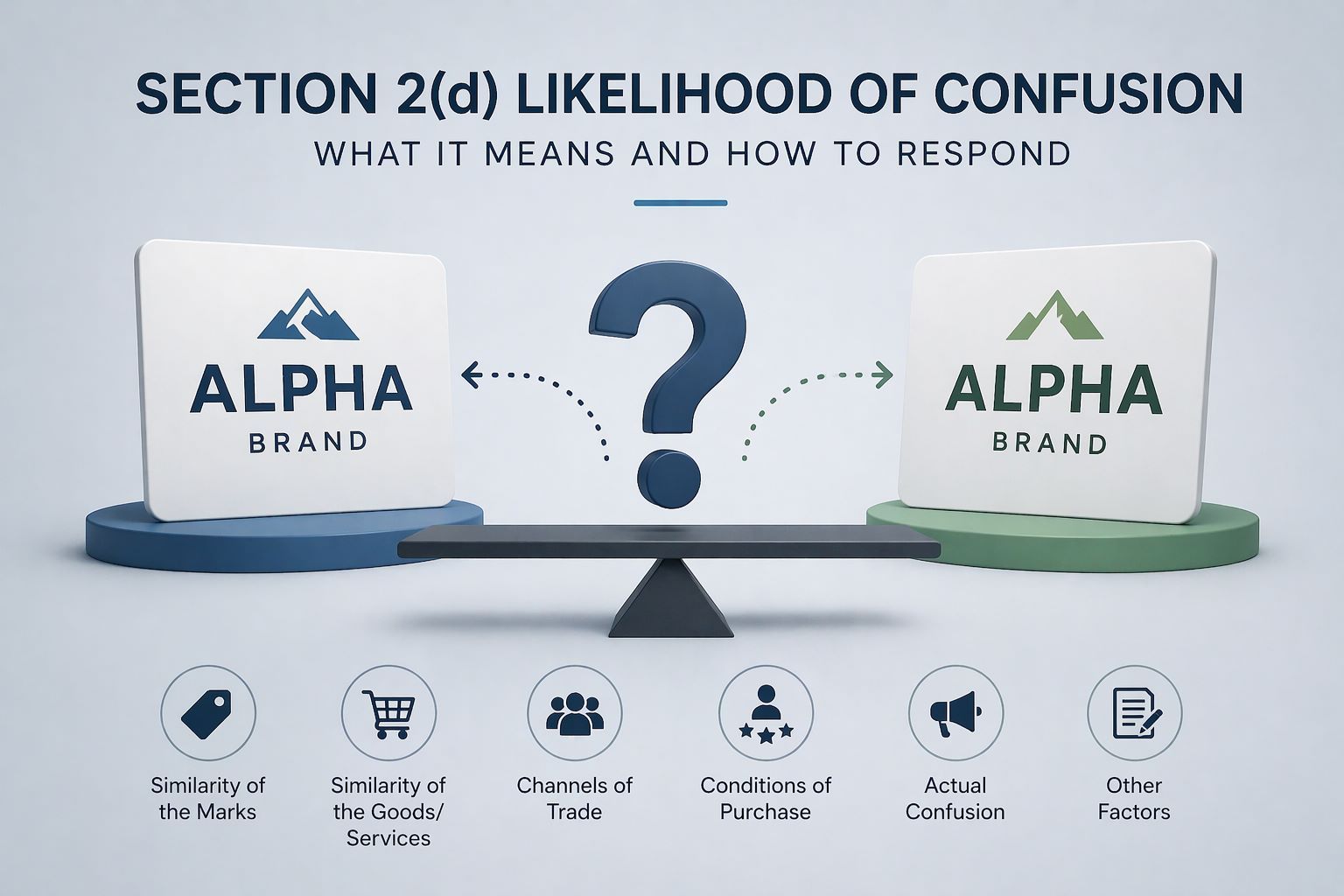
One of the most common reasons trademark applications are refused by the United States Patent and Trademark Office (USPTO) is the so-called Likelihood of Confusion refusal under Section 2(d) of the Lanham Act.
For many applicants, this refusal comes as a surprise. After investing time and resources into building a brand, receiving an Office Action claiming that the trademark is too similar to an existing mark can feel discouraging.
However, a Section 2(d) refusal does not necessarily mean the end of your trademark application. Many applicants successfully overcome it with a well-structured response.
Understanding how the USPTO evaluates confusion — and how to respond strategically — is essential for protecting your brand.
What Is a Section 2(d) Likelihood of Confusion Refusal?
A Likelihood of Confusion refusal occurs when a USPTO examining attorney believes that consumers may mistakenly assume two trademarks come from the same source.
According to the USPTO:
➡ Likelihood of confusion explanation (USPTO)
The examiner compares your trademark with existing registered or pending marks to determine whether the public might believe the products or services are related.
If such confusion is considered likely, the USPTO may refuse registration under Section 2(d) of the Lanham Act.
Why the USPTO Takes Likelihood of Confusion Seriously
Trademark law primarily exists to protect consumers from confusion in the marketplace.
If two brands appear too similar, customers may:
- purchase the wrong product
- assume the brands are affiliated
- believe one brand is endorsed by another
Because of this, preventing confusion is a core principle of U.S. trademark law.
How the USPTO Determines Likelihood of Confusion
The USPTO evaluates trademark conflicts using a legal framework derived from the DuPont factors, a set of criteria established by trademark case law.
While there are 13 DuPont factors, examining attorneys usually focus on the most relevant ones.
| Key Factor | What the USPTO Evaluates |
|---|---|
| Similarity of the marks | Appearance, sound, meaning |
| Relatedness of goods/services | Whether products are commercially related |
| Trade channels | Where the products are sold |
| Consumer sophistication | How careful buyers are |
| Strength of existing mark | How distinctive the cited mark is |
Even if trademarks are not identical, similarity in these areas may lead to refusal.
➡ USPTO trademark examination guidance
Example of a Likelihood of Confusion Scenario
| Existing Trademark | New Application | Reason for Refusal |
|---|---|---|
| QUICKBYTE | QUICKBIT | Similar pronunciation |
| CLOUDSYNC | CLOUDSYNK | Nearly identical appearance |
| FRESHBITE | FRESHBYTE | Similar meaning and industry |
In such cases, the USPTO may determine that consumers could reasonably believe the brands come from the same company.
What Happens When You Receive a Section 2(d) Refusal?
A likelihood of confusion refusal is typically issued in a Non-Final Office Action.
This means the examining attorney is giving you the opportunity to respond and present arguments.
➡ USPTO responding to Office Actions
Your response must address the examiner’s reasoning and explain why confusion is unlikely.
If the examiner disagrees with the response, they may issue a Final Office Action.
For a broader explanation of Office Actions, see:
➡ Trademark Office Action guide (TrademarkFactory)
Strategies for Responding to a Likelihood of Confusion Refusal
Overcoming a Section 2(d) refusal requires a legal argument demonstrating that confusion is unlikely.
Below are common strategies used in successful responses.
1. Demonstrating Differences Between the Marks
Even small differences in appearance, sound, or meaning can reduce the likelihood of confusion.
Example:
| Trademark A | Trademark B | Key Difference |
|---|---|---|
| SKYLAB | SKYLABS | Plural form changes meaning |
| REDRAY | REDRIDE | Different pronunciation |
Highlighting these distinctions can help show that consumers will recognize the brands as separate.
2. Showing Goods or Services Are Unrelated
If the goods or services are different enough, confusion may be unlikely.
Example:
| Trademark | Industry |
|---|---|
| ORBIT | Computer software |
| ORBIT | Fitness equipment |
Even identical names may coexist if they serve unrelated markets.
3. Narrowing the Goods or Services Description
Sometimes the refusal can be resolved by amending the description of goods or services.
Example:
Original description
“Software”
Amended description
“Software for medical imaging analysis”
This can reduce overlap with the cited trademark.
4. Demonstrating Weakness of the Cited Trademark
If many similar trademarks already exist, the cited mark may be considered weak.
Example:
Evidence of widespread use can reduce the strength of a cited mark.
Can a Section 2(d) Refusal Be Overcome?
Yes — many likelihood of confusion refusals are successfully resolved.
Possible outcomes include:
| Outcome | Result |
|---|---|
| Examiner accepts response | Application proceeds |
| Examiner maintains refusal | Final Office Action issued |
| Applicant appeals | Case reviewed by TTAB |
➡ USPTO TTAB appeals information
Strategic responses that address the examiner’s reasoning often significantly improve approval chances.
How to Avoid Likelihood of Confusion Problems
The best strategy is prevention.
Before filing a trademark application, applicants should conduct a comprehensive trademark search to identify potential conflicts.
➡ USPTO trademark search system (TESS)
A proper search can reveal similar marks and help applicants adjust their brand before filing.
FAQ: Section 2(d) Likelihood of Confusion
What is a Section 2(d) refusal?
A Section 2(d) refusal occurs when the USPTO believes your trademark is too similar to an existing mark and may confuse consumers.
Is likelihood of confusion the most common trademark refusal?
Yes. It is one of the most frequent reasons the USPTO refuses trademark applications.
Can similar trademarks coexist?
Yes, if the goods or services are unrelated or the marks create different commercial impressions.
How long do I have to respond to a likelihood of confusion refusal?
Applicants typically have three months to respond to an Office Action.
Can I overcome a Section 2(d) refusal?
Yes. Many refusals are resolved by: legal arguments, amending goods/services, presenting evidence that confusion is unlikely.
What happens if the examiner rejects my response?
The USPTO may issue a Final Office Action, after which you can request reconsideration or appeal to the Trademark Trial and Appeal Board (TTAB).
Do I need a trademark attorney to respond?
While applicants may respond themselves, likelihood of confusion refusals often involve complex legal analysis and trademark case law.
' width='400' height='200'/%3E%3C/svg%3E)