

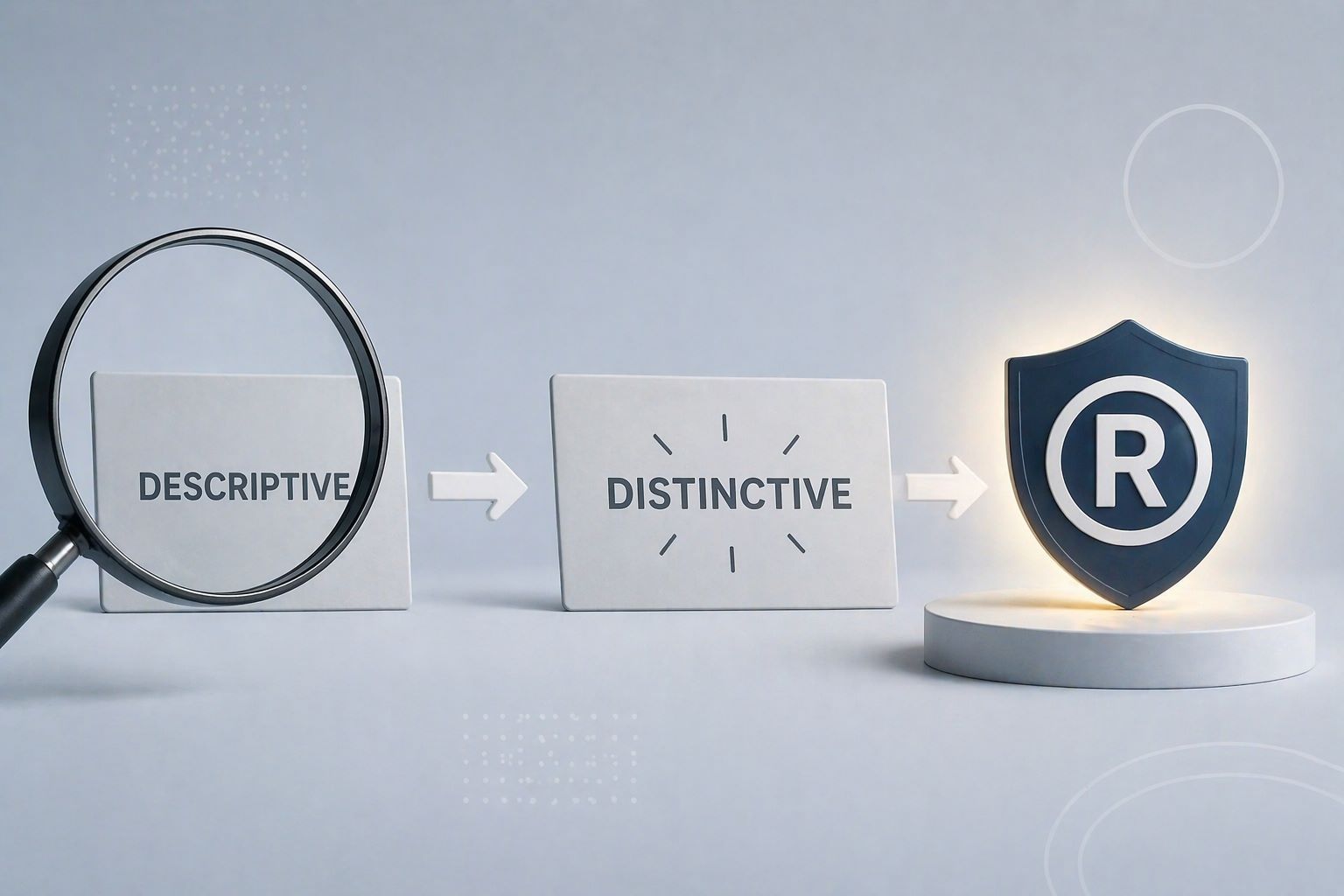
One of the most common challenges trademark applicants face is a descriptiveness refusal issued by the United States Patent and Trademark Office (USPTO).
Many businesses naturally choose names that describe their products or services. While this may be helpful from a marketing perspective, it can create problems during the trademark registration process.
If the USPTO determines that your trademark merely describes the goods or services, the application may be refused under Section 2(e)(1) of the Lanham Act.
The good news is that a descriptiveness refusal does not always mean the end of the application. Understanding how descriptiveness works — and how to respond — can often help applicants move forward with registration.
What Is a Descriptive Trademark?
A descriptive trademark is a mark that directly describes a quality, feature, function, or characteristic of the goods or services it represents.
According to the USPTO:
➡ USPTO grounds for refusal (Descriptiveness)
Examples of descriptive marks include:
| Trademark | Product | Why It’s Descriptive |
|---|---|---|
| COLD & CREAMY | Ice cream | Describes the product |
| QUICK PRINT | Printing services | Describes speed |
| SMART SECURITY | Security systems | Describes functionality |
Because descriptive terms are commonly used by many businesses, trademark law generally prevents one company from monopolizing them.
Why the USPTO Refuses Descriptive Trademarks
Trademark protection is designed to help consumers identify the source of goods or services, not simply describe them.
If descriptive terms were freely registered as trademarks, competitors might be prevented from using ordinary language to describe their products.
For this reason, the USPTO often refuses descriptive marks unless the applicant can demonstrate that the mark has acquired distinctiveness.
➡ USPTO trademark distinctiveness explanation
The Spectrum of Trademark Distinctiveness
To understand descriptiveness refusals, it is useful to see where descriptive marks fall within the broader spectrum of trademark distinctiveness.
| Type of Mark | Example | Registrability |
|---|---|---|
| Generic | “Milk” for dairy | Never registrable |
| Descriptive | “Creamy Yogurt” | Usually refused |
| Suggestive | “Netflix” | Registrable |
| Arbitrary | “Apple” for computers | Strong trademark |
| Fanciful | “Kodak” | Strongest trademark |
Descriptive marks sit in the middle of the spectrum, making them more difficult to register than distinctive brand names.
How the USPTO Determines Descriptiveness
When evaluating descriptiveness, examining attorneys consider whether consumers would immediately understand the mark as describing the product.
The key test is:
Does the trademark directly convey information about the goods or services without requiring imagination?
If the answer is yes, the mark may be considered descriptive.
Examples of Descriptive Trademark Refusals
Below are common situations where the USPTO may issue a descriptiveness refusal.
| Trademark | Product | Reason for Refusal |
|---|---|---|
| FAST DELIVERY | Courier service | Describes service |
| ORGANIC JUICE | Beverage products | Describes ingredients |
| EASY TAX | Tax preparation software | Describes function |
In each case, the mark directly describes what the product does or what it contains.
How to Respond to a Descriptiveness Refusal
Applicants have several potential strategies when responding to a descriptiveness refusal.
Responses must address the examining attorney’s reasoning and explain why the mark should still qualify for registration.
➡ USPTO responding to Office Actions
1. Arguing the Mark Is Suggestive, Not Descriptive
Sometimes a mark requires imagination or interpretation to understand the connection between the name and the product.
Example:
| Mark | Product | Reason It May Be Suggestive |
|---|---|---|
| GREYHOUND | Bus services | Suggests speed |
| COPPERTONE | Sunscreen | Suggests tanning |
Suggestive marks are registrable because they do not directly describe the product.
2. Claiming Acquired Distinctiveness (Secondary Meaning)
Even descriptive marks may be registered if the applicant proves that consumers associate the mark with a specific company.
This is known as acquired distinctiveness under Section 2(f).
Evidence may include:
- long-term use of the trademark
- advertising expenditures
- media recognition
- consumer surveys
➡ USPTO acquired distinctiveness explanation
3. Amending the Application to the Supplemental Register
If the mark is descriptive but still used in commerce, applicants may request registration on the Supplemental Register.
The Supplemental Register offers limited protection but allows the mark to gain distinctiveness over time.
➡ USPTO Supplemental Register information
How to Avoid Descriptiveness Problems
The best strategy is choosing a trademark that is inherently distinctive.
Before filing a trademark application, businesses should evaluate whether the name:
- directly describes the product
- uses common industry terms
- simply describes features or benefits.
More distinctive marks typically have stronger legal protection.
For more information about Office Actions and how they affect trademark applications, see:
➡ TrademarkFactory Office Action guide
Can Descriptive Trademarks Become Strong Brands?
Yes — some well-known brands began as descriptive terms but later gained strong consumer recognition.
However, this typically requires significant marketing and long-term use.
Until a descriptive mark gains recognition, the USPTO may require additional evidence before granting full trademark protection.
FAQ: Trademark Descriptiveness Refusal
What is a descriptiveness refusal?
A descriptiveness refusal occurs when the USPTO determines that a trademark directly describes the goods or services offered.
Can descriptive trademarks ever be registered?
Yes. If the applicant proves acquired distinctiveness, the trademark may become registrable.
What is acquired distinctiveness?
Acquired distinctiveness means consumers recognize the descriptive term as identifying a specific brand rather than merely describing the product.
What is the Supplemental Register?
The Supplemental Register allows descriptive trademarks that are already used in commerce to receive limited trademark protection.
How long do I have to respond to a descriptiveness refusal?
Applicants generally have three months to respond to an Office Action, with the possibility of a three-month extension.
Should I change my trademark if it is descriptive?
In some cases, rebranding to a more distinctive name may be the easiest path to registration.
Is a descriptive trademark weaker legally?
Yes. Descriptive marks typically provide weaker legal protection than distinctive trademarks.
' width='400' height='200'/%3E%3C/svg%3E)