

💡
The Trademark Trial and Appeal Board (TTAB) recently affirmed the refusal to register the trademark WISHBONES for bar services inside a casino, finding it confusingly similar to the already registered mark WISHBONE FARMS for restaurant, catering, and carryout services.
This ruling highlights how even modest similarities between marks — especially when used in related service industries — can trigger a likelihood of confusion refusal under Section 2(d) of the Lanham Act.
This ruling highlights how even modest similarities between marks — especially when used in related service industries — can trigger a likelihood of confusion refusal under Section 2(d) of the Lanham Act.
Case Summary: Why the USPTO Said No
The applicant, Caesars License Company, LLC, argued that the term FARMS dramatically changes the meaning and feel of the earlier mark, distancing WISHBONES from WISHBONE FARMS.
According to Caesars:
- WISHBONES evokes luck, gambling culture, or even a personal name.
- WISHBONE FARMS suggests agriculture, farm-to-table concepts, or rural origins.
However, the USPTO examining attorney — and later the TTAB — disagreed.
You can read similar TTAB decisions on the official USPTO TTAB portal
Why the TTAB Found a Likelihood of Confusion
The Board emphasized several key legal points:
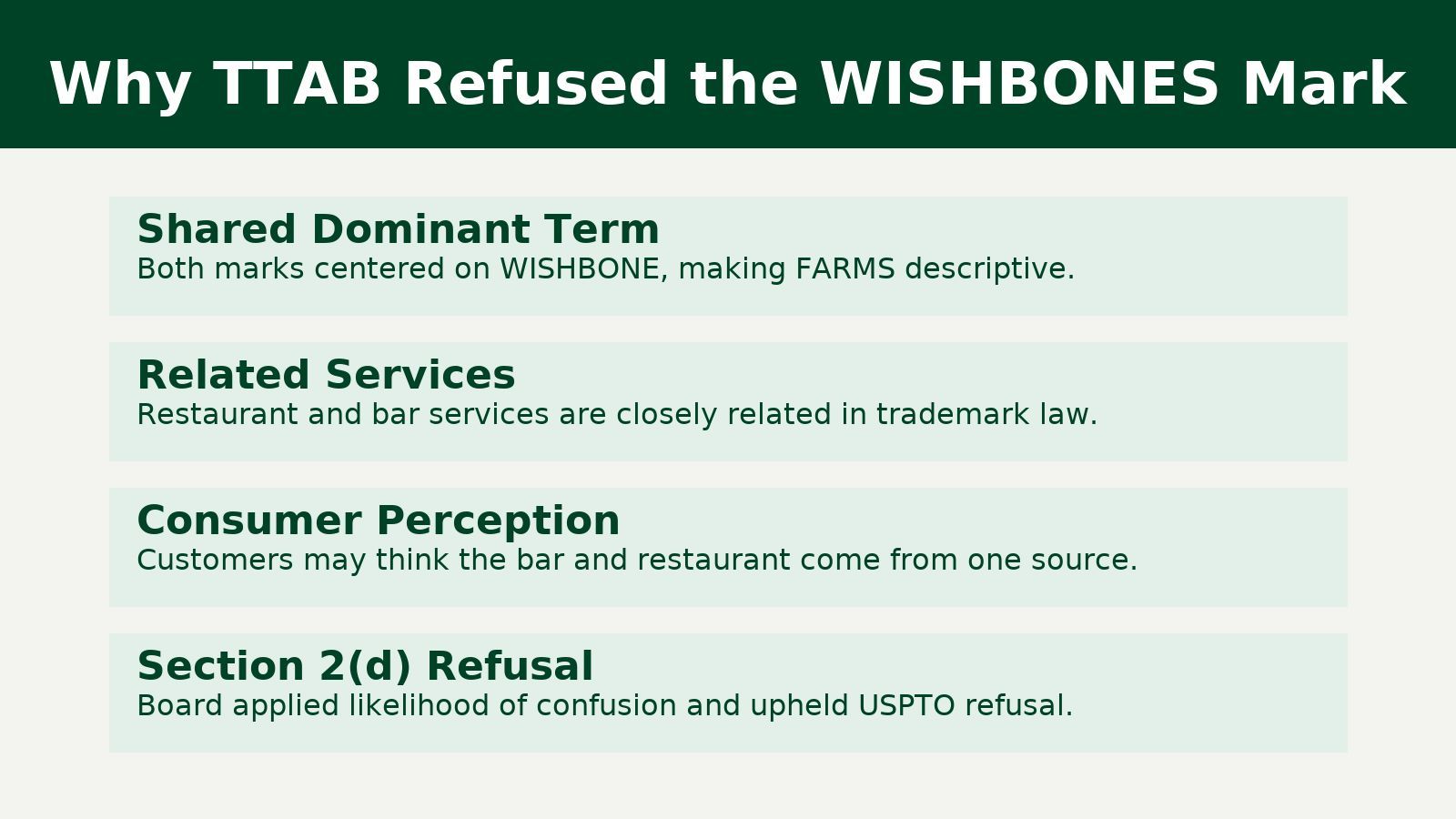
- “FARMS” is descriptive, so consumers are more likely to focus on the distinctive shared element: WISHBONE.
- Restaurant and bar services are considered related services in trademark law.
- Consumers often perceive marks sharing a dominant term as coming from the same provider, especially in the food and hospitality sectors.
- Prior registrations where FARM or FARMS coexisted did not matter, because each case must be evaluated based on its record.
This reinforces an important principle:
👉 If two marks share a central, memorable term, even small differences are rarely enough to overcome a confusion refusal.
More background on likelihood of confusion standards:
🔗 USPTO TMEP §1207
' width='400' height='200'/%3E%3C/svg%3E)


This case is a great reminder that you cannot rely on tiny differences between your trademark and someone else’s registered trademark and expect the Trademarks Office to play along.
We see this all the time. A client comes to us, we run a search, and we find something that isn’t identical but is very close. And the client goes, “Well, ours is slightly different. The spelling is different. We added a word. We removed a word. So we think it should go through.” And we have to tell them—that’s not how it works.
But they still push back: “It’s not the same thing. It conveys a slightly different meaning.” And yes, to them it does. But the Trademarks Office doesn’t care about those micro-distinctions. Their job is to maintain certainty in the marketplace. If everyone could just add or remove a word and instantly claim new rights, the value of the earlier trademark would collapse.
That’s why the Office almost never buys these arguments. And this case shows it perfectly.
You are always better off owning something truly unique—something you can actually enforce—than trying to thread the needle and convince the Office that your “almost identical but technically different” brand deserves a registration. Even if you somehow got it through, your ability to enforce it would be severely limited.
So the lesson here is brutally simple: If you’re a business owner and your search uncovers something similar, don’t fight reality. Don’t spend years and thousands of dollars trying to trademark a brand you love but cannot own.
You are always better off owning something truly unique—something you can actually enforce—than trying to thread the needle and convince the Office that your “almost identical but technically different” brand deserves a registration. Even if you somehow got it through, your ability to enforce it would be severely limited.
Come up with a new brand. One that’s actually yours. One you can claim, protect, and build on. That’s how you create real value.